
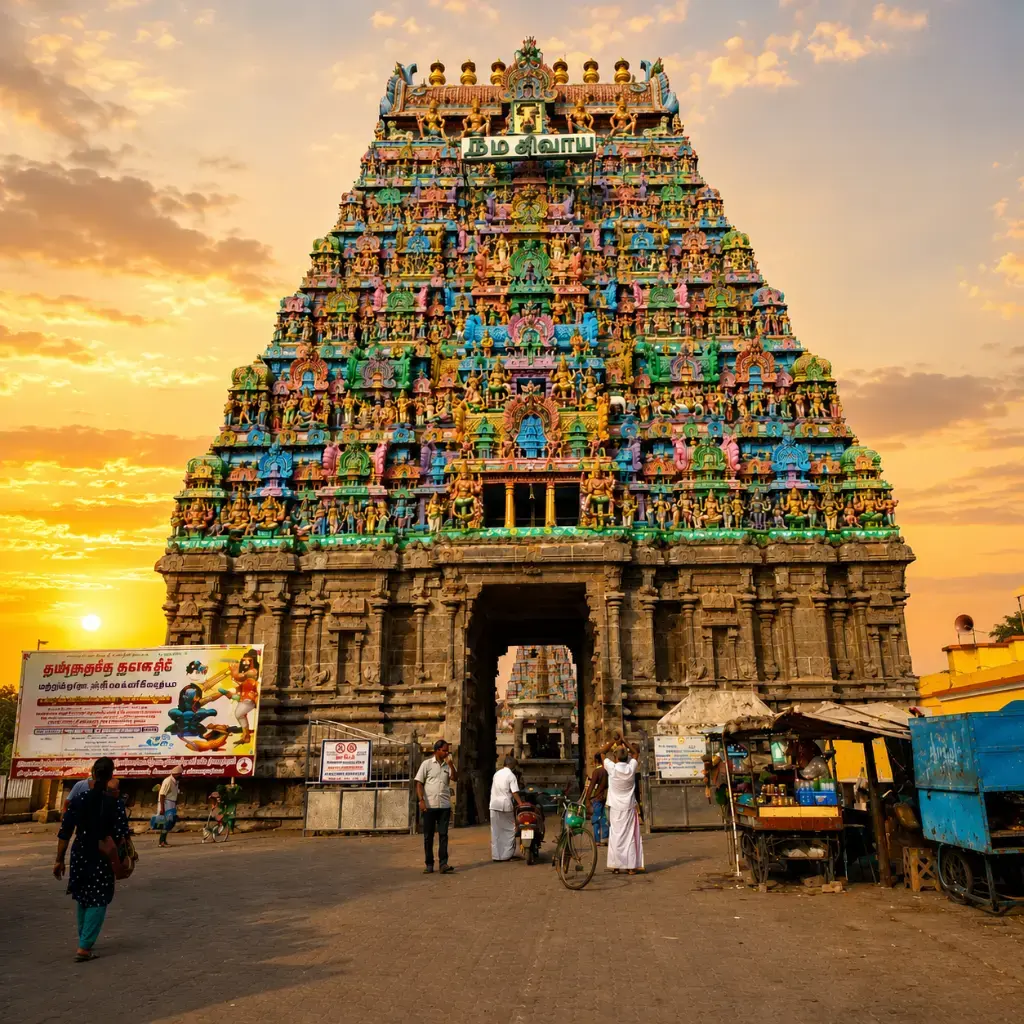
Arulmigu Kalyana Pasupatheeswarar Temple
அருள்மிகு கல்யாண பசுபதீஸ்வரர் திருக்கோவில், கரூர்
Lord Shiva · Karur, Tamil Nadu
✓ VerifiedAncient★ 4.73,400 reviews
About the temple
Extremely High (7th of the 7 Paadal Petra Sthalams in the Kongu region). Accords marital harmony (hence Kalyana), removes obstacles in progeny, balances planetary afflictions, and grants liberation from past karmas.
Temple information
- Darshan timings
- 06:00 – 21:00
- Best time to visit
- Early morning hours on mid-week non-festival days to experience a peaceful darshan atmosphere
Deity
Lord Shiva · ଶିବ (Shiva)
- Deity form
- Swayambhu Lingam (Five-foot tall granite Lingam, tilted slightly to the north, bearing a distinct scar marks believed to be from the hoof of Kamadhenu).
- Religious tradition
- Tamil Shaiva Agama traditions
- Sanskrit name
- श्री कल्याण पशुपतीश्वर मन्दिरम्
- Also known as
- Karur Pasupatheeswarar Kovil, Thiruvanilai, Anilai Shiva Temple
Darshan hours
- Monday
- 06:00-12:00, 16:00-21:00
- Tuesday
- 06:00-12:00, 16:00-21:00
- Wednesday
- 06:00-12:00, 16:00-21:00
- Thursday
- 06:00-12:00, 16:00-21:00
- Friday
- 06:00-12:00, 16:00-21:00
- Saturday
- 06:00-12:00, 16:00-21:30
- Sunday
- 06:00-12:00, 16:00-21:00
- Break timings
- 12:00PM -04:00PM
- Special days
- 04:30-23:00 (Extended during Panguni Uthiram, Maha Shivaratri, and Pradosham cycles).
- Festival timings
- During the Brahmotsavam and major Pradosham days, the inner mandapams remain active continuously from 04:00 AM until late midnight.
Aarti & rituals
- Morning aarti
- 06:30 AM
- Midday aarti
- 11:45 AM
- Evening aarti
- 5:30 PM
- Night aarti
- 8:15 PM
- Special aarti days
- Pradosham evenings feature grand musical processions and detailed multi-tier abhishekams.
- Ritual schedule
- Six structured daily Agamic puja blocks performed systematically by the hereditary priests.
- Pooja timings
- 16:30 - 18:00 (Pradosha Abhishekam slots) and special Kalyana Utsavam timings on request.
- Abhishek timings
- 07:00 AM and 11:00 AM daily across the major shrines.
- Special poojas
- Pradosha Abhishekam, Kalyana Utsavam, Vahana Sevas, Sahasranama Archana, and Navagraha Shanti Homam.
- Online pooja booking
- Via portal
History & heritage
- Historical period
- Ancient
- Built by
- Structural stone temple constructed by the Imperial Cholas, with major modifications and expansion corridors added by the Kongu Cheras and Pandyan kings.
- Architect / builder
- Built under royal supervision by guilds of Chola Sthapathis (architects).
- Construction materials
- Premium hard granite stone block foundations paired with brick-and-lime mortar structural towers.
- Historical events
- Celebrated in the 7th-century Tevaram corpus by Saint Sambandar. It is the birthplace of Eripatha Nayanar, who famously killed a royal Chola elephant to protect a devotee's flowers.
- Renovations
- Major historical rebuilding recorded under Rajendra Chola I. Extensive structural renovations and Kumbhabhishekam cycles were executed in modern times.
- Archaeological importance
- Centrally protected living cultural heritage site monitored in partnership with state religious and historical departments.
- Legends
- Lord Brahma grew proud of his role as the creator. To humble him, Lord Shiva sent the divine cow Kamadhenu to earth. Kamadhenu arrived at this forest of Vanjavan (Karur), found a hidden Shiva Lingam under the earth, and began bathing it daily with her milk. One day, her hoof accidentally struck the underground stone object. Terrified, she apologized, but Lord Shiva emerged and declared that the visible hoof mark on his head would remain forever as a mark of her pure devotion.
- Inscriptions
- Over 25 detailed stone inscriptions detailing grants of land, gold coins, and oil for lamps by Chola monarchs like Rajaraja I and Rajendra I.
Architecture
- Architectural style
- Dravidian
- Architectural period
- Major stone structural configuration completed between the 10th and 13th Centuries CE.
- Structure
- Large, expansive urban temple complex featuring multiple layered corridors (prakarams) and high perimeter stone walls.
- Floors
- 1
- Gopuram
- Features a spectacular 120-foot tall, 7-tiered Rajagopuram facing east, alongside a smaller multi-tier western gopuram entryway.
- Mandapa
- Features the grand 100-Pillar Mandapam adorned with detailed stone pillars, alongside an intricately carved Alankara Mandapam.
- Sculptural features
- Magnificent monolithic stone sculptures depicting the battle between Eripatha Nayanar and the royal elephant, along with intricate representations of the 63 Nayanars.
- Artistic elements
- The ceiling of the main corridors features beautiful traditional iconographic depictions of Saivite lore and the history of Karur.
- Construction technique
- Advanced Dravidian interlocking stone masonry engineered perfectly to support massive weight overhead without internal binding failures.
- Unique features
- Uniquely features two distinct separate shrines for the Divine Mother within the same outer complex: Goddess Alankaravalli (facing east) and Goddess Soundaranayagi (facing south).
Festivals & events
- Festival calendar
- Programmed precisely according to the Tamil astrological panchangam cycles.
- Special celebration days
- During the annual festival month of Panguni (March-April), for three consecutive days, the sun rays fall directly upon the main Swayambhu Lingam in the inner sanctum—a breath-taking astronomical phenomenon.
- Cultural events
- Grand classical dance festivals (Natyanjali) during Shivaratri and devotional musical concerts throughout the Brahmotsavam season.
- Annual events
- The massive 13-day Panguni Uthiram Brahmotsavam featuring the grand chariot car run, the float festival (Theppotsavam), and the Eripatha Nayanar historical reenactment ceremony.
- Peak crowd season
- The festive transition block of March-April (Panguni) and the complete dynamic spell of the winter festival months (October to January).
Visitor information
- ✓ Parking
- ✓ Wheelchair accessible
- ✓ Restrooms
- ✓ Drinking water
- ✓ Shoe keeping
- ✓ Prasadam counter
- ✓ Annadanam
- Dress code
- Traditional
- Best time to visit
- Early morning hours on mid-week non-festival days to experience a peaceful darshan atmosphere
- Parking capacity
- 30-40 vehicles
- Parking fees
- Approx. 20-50 INR
- Donation counters
- Yes
- Donation methods
- Cash, UPI, Bank Transfer
- Prasadam
- Blessed Vibhuti and Kumkum distributed post-ritual; delicious hot Puliyodarai (tamarind rice) distributed during special morning hours.