
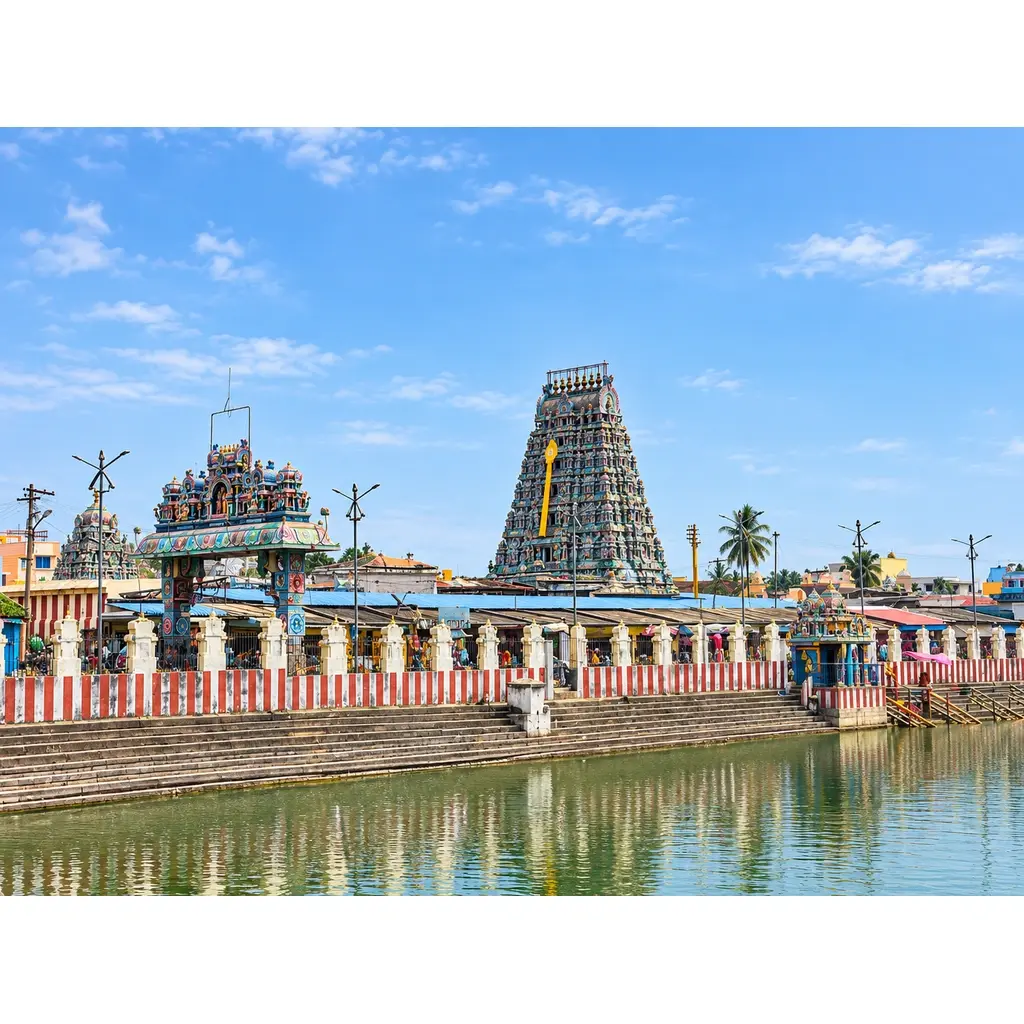
Arulmigu Kandaswamy Temple
அருள்மிகு கந்தசுவாமி திருக்கோயில்
Lord Murugan · Tirupporur, Tamil Nadu
Ancient
About the temple
Celebrated as "Samarapuri" (the city of the holy combat); holy site where Lord Murugan vanquished Tarakasura in the battle of earth (Bhoomi Samharam); consecrated by 17th-century saint Chidambara Swamigal who extracted the hidden deity from the anthill under divine guidance. Traditional belief: Complete removal of evil spells, black magic, fear of enemies, relief from Angaraka (Mars) / Sevvai Dosha, and childlessness.
Temple information
- Darshan timings
- 06:00 – 20:30
- Established
- 10
- Best time to visit
- Early morning hours on mid-week non-festival days to experience a peaceful darshan atmosphere
Deity
Lord MuruganGanesha Family
- Deity form
- Self-manifested (Swayambhu) anthill (Valmeeka) image of Lord Murugan in standing warrior posture with Valli and Devasena
- Religious tradition
- Vedic Agamic Kaumara Tradition of Tamil Nadu
- Sanskrit name
- श्री स्कन्दस्वामी मन्दिरम्
- Also known as
- Tirupporur Murugan Temple, Samarapuri Kandaswamy Temple, Porur Murugan Gudi
Darshan hours
- Daily
- 06:00 AM - 12:30 PM, 04:00 PM - 08:30 PM
- Break timings
- 12:30 PM - 04:00 PM (Monday to Thursday)
- Special days
- Soorasamharam, Thaipusam, Vaikasi Visakam: 04:00 AM - 11:30 PM
- Festival timings
- Open continuously till 11:30 PM during Skanda Sashti and festival days
Aarti & rituals
- Morning aarti
- 07:30 AM
- Midday aarti
- 12:00 PM
- Evening aarti
- 06:00 PM
- Night aarti
- 8:15 PM
- Special aarti days
- Every Kiruthigai (monthly), Tuesdays, Sashti, Thaipusam, Panguni Uthiram
- Ritual schedule
- Nitya Arukala Puja, Ksheerabhishekam, Sandal paste Alankara, Sahasranamarchana, Chariot procession on festival days
- Pooja timings
- 06:30 AM - 12:00 PM, 04:30 PM - 08:00 PM
- Abhishek timings
- Since the Moolavar is Swayambhu Valmeeka (clay anthill), Abhisheka is performed only to the Utsavar and Sannidhi Yantra; special Thirumanjanam at 07:00 AM
- Special poojas
- Available
- Online pooja booking
- No
History & heritage
- Historical period
- Ancient
- Built by
- Pallava-Chola foundations; rebuilt by Saint Chidambara Swamigal with patronage from Madurai Nayakas
- Architect / builder
- Traditional Tamil temple sthapathis
- Construction materials
- Granite stone masonry, brick-lime Rajagopuram, brass flagstaff, sacred teertham
- Historical events
- Saint Chidambara Swamigal, a direct descendant of the Madurai Meenakshi temple lineage, had a divine vision of Lord Murugan guiding him to uncover the lost shrine under palm groves
- Renovations
- Protected and developed under Tamil Nadu HR&CE Department with new Rajagopuram and Annadana mandapams
- Archaeological importance
- Epigraphical records mentioning grants by Chola King Rajendra III and Vijayanagara monarchs
- Legends
- Lord Murugan fought the Asuras at three cosmic battlefields: in the sky at Tiruchendur, in the waters at Tirupparankunram, and on the land (Bhoomi) at Tirupporur
- Inscriptions
- Stone inscriptions in Tamil dating from the 12th to 17th century recording endowments to Samarapuri Kandaswamy
Architecture
- Architectural style
- Dravidian
- Architectural period
- 17th Century CE structural complex
- Structure
- Sprawling walled temple township featuring seven-tiered entrance Rajagopuram, sacred Pranavamrita Teertham tank, broad pillared cloisters, and Chidambara Swamigal Matha
- Floors
- 1
- Gopuram
- Soaring seven-tiered 108-foot entrance Rajagopuram embellished with stucco sculptures of Skanda Purana legends
- Mandapa
- Spacious Mukhamandapa and 24-pillared hall supported by carved granite pillars depicting yalis and warriors
- Sculptural features
- Swayambhu murti of Lord Kandhaswamy holding Vel; beautiful standing bronze icons of Murugan with consorts; sacred Sri Yantra installed by Chidambara Swamigal
- Artistic elements
- Intricate stone ceiling carvings, embossed silver Kavacham, and massive brass peacock flagstaff (Kodimaram)
- Construction technique
- Interlocking monolithic granite block masonry joined with mortar superstructure
- Unique features
- The sacred self-manifested Swayambhu anthill deity to whom special sandal paste (Santhana Kappu) is applied; holy dip in Pranavamrita Teertham
Festivals & events
- Festival calendar
- Aippasi Sashti (Soorasamharam), Thai Poosam (January/February)
- Special celebration days
- Every Kiruthigai, Tuesdays, Sashti
- Cultural events
- Carnatic vocal concerts, Nadaswaram recitals, and dramatic re-enactment of Soorasamharam during Skanda Sashti
- Annual events
- Tirupporur Maha Brahmotsavam and Soorasamharam drawing over 200,000 pilgrims
- Peak crowd season
- October to February, every monthly Kiruthigai, and during summer holidays
Visitor information
- ✓ Parking
- ✓ Restrooms
- ✓ Drinking water
- ✓ Shoe keeping
- ✓ Prasadam counter
- Dress code
- Traditional
- Best time to visit
- Early morning hours on mid-week non-festival days to experience a peaceful darshan atmosphere
- Parking capacity
- 100+ Vehicles
- Parking fees
- Approx. 20-50 INR
- Donation counters
- Yes
- Donation methods
- Cash, UPI, Bank Transfer
- Prasadam
- Vibhuti/Kumkum.