
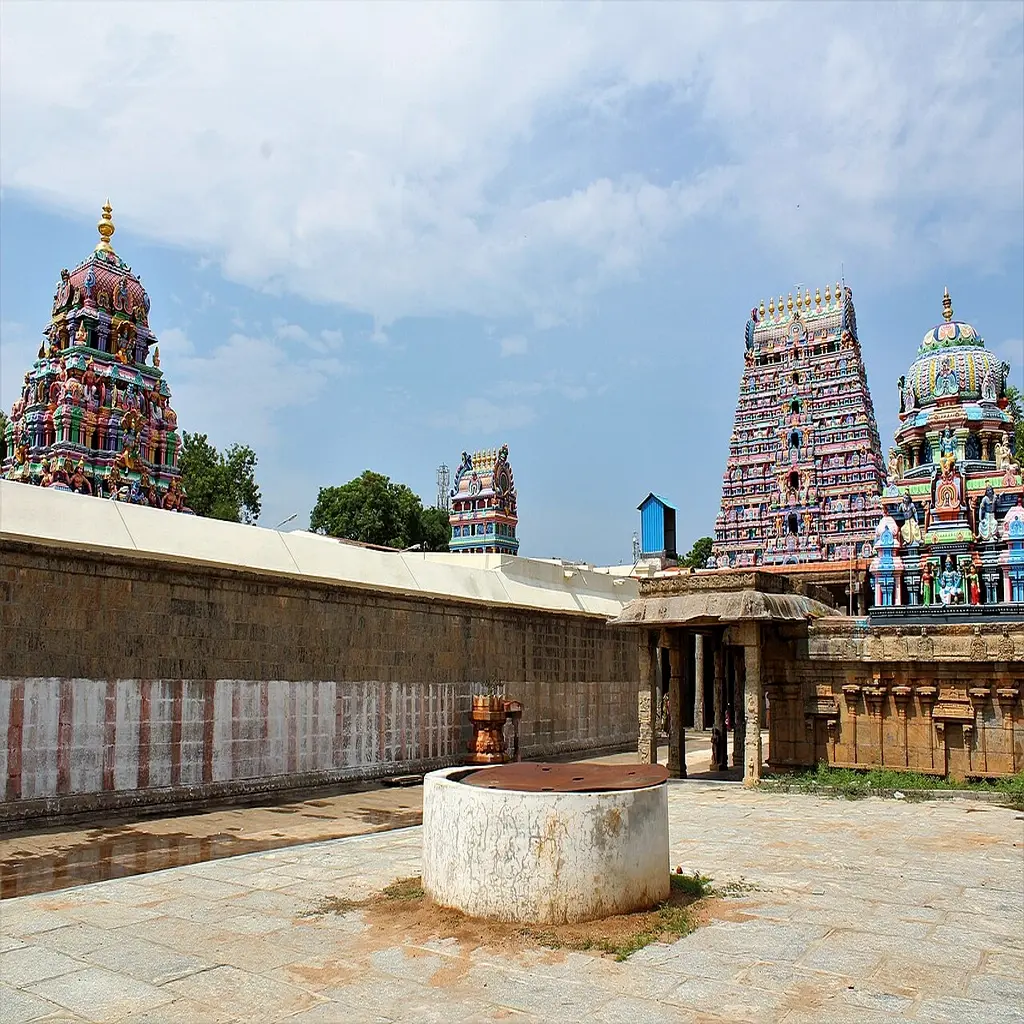
Bhu Varaha Swamy Temple
ஸ்ரீ பூவராக சுவாமி திருக்கோயில்
Lord Varaha Swamy · Srimushnam, Tamil Nadu
Ancient
About the temple
One of the eight foremost self-manifested (Ashta Swayamvyakta) Kshetras of Lord Vishnu in India (alongside Srirangam, Tirupati, Badrinath, Muktinath, Naimisharanya, Pushkar, and Thothadri); where Lord Varaha rested after vanquishing demon Hiranyaksha and rescuing Mother Earth; famed for the Nithya Kalyana Theertham whose sweat of Varaha created the lake; famous for communal harmony during the Masi festival where the temple chariot halts at the local Muslim dargah. Traditional belief: Supreme removal of fear of untimely death, curing of speech and kidney ailments, grant of progeny, and liberation from ancestral sins.
Temple information
- Darshan timings
- 06:00 – 20:30
- Best time to visit
- Early morning hours on mid-week non-festival days to experience a peaceful darshan atmosphere
Deity
Lord Varaha SwamyBhudevi
- Deity form
- Rare small self-manifested (Swayamvyakta) black Saligrama stone icon of Lord Varaha with hands placed on his hips (Kati Hastha), his boar face turned towards the west while his human torso faces south
- Religious tradition
- Vedic Pancharatra Agamic Tradition & Ashta Swayamvyakta Kshetra Heritage
- Sanskrit name
- श्री भूवराहस्वामी मन्दिरम्
- Also known as
- Srimushnam Varaha Temple, Ashta Swayamvyakta Kshetra Srimushnam, Nithya Kalyanar Srimushnam
Darshan hours
- Daily
- 06:00 AM - 12:00 PM, 04:30 PM - 08:30 PM
- Break timings
- 12:00 PM - 04:30 PM (Monday to Thursday)
- Special days
- Masi Magham Brahmotsavam, Vaikunta Ekadashi: 04:00 AM - 11:30 PM
- Festival timings
- Open continuously till 11:30 PM during Masi Magham and Vaikunta Ekadashi
Aarti & rituals
- Morning aarti
- 07:00 AM
- Midday aarti
- 11:45 AM
- Evening aarti
- 06:00 PM
- Night aarti
- 8:15 PM
- Special aarti days
- Every Saturday, Shukla Ekadashi, Masi Magham, Fridays for Ambujavalli
- Ritual schedule
- Nitya Thiruvaradhana, Thulasi Archana, Sahasranamarchana, Nithya Pushkarini Theerthavari, Chariot procession
- Pooja timings
- 06:30 AM - 12:00 PM, 04:30 PM - 08:00 PM
- Abhishek timings
- Since Moolavar is Saligrama stone, special Thirumanjanam is performed with oil and holy waters daily at 07:00 AM
- Special poojas
- Available
- Online pooja booking
- No
History & heritage
- Historical period
- Ancient
- Built by
- Vijayanagara Emperor Achyuta Deva Raya and Thanjavur Nayaka King Sevappa Nayaka
- Architect / builder
- Master traditional royal sthapathis of the Vijayanagara court
- Construction materials
- Solid dressed dark granite, brick-lime soaring Rajagopurams, brass flagstaff, massive stone stepwell
- Historical events
- The Nawab of Arcot gifted villages and established the unique communal tradition where the temple deity visits the Muslim Dargah at Killai during Masi Magham
- Renovations
- Protected and renovated under Tamil Nadu HR&CE Department with new granite stone pathways, lighting, and guest house renovations
- Archaeological importance
- Epigraphical records detailing the reign of Vijayanagara emperors and Nayaka chieftains
- Legends
- Lord Varaha took a holy dip in Nithya Pushkarini after slaying Hiranyaksha; the holy lake water is believed to be saturated with the sweat (Sveda) of Lord Vishnu
- Inscriptions
- More than 20 stone inscriptions in Tamil, Telugu, and Sanskrit recording endowments by Achyuta Raya and Sevappa Nayaka
Architecture
- Architectural style
- Dravidian
- Architectural period
- 16th Century CE
- Structure
- Vast walled temple complex with seven-tiered entrance Rajagopuram, 100-pillared Purushasukta Mandapa, Ambujavalli shrine, and colossal Nithya Pushkarini lake
- Floors
- 1
- Gopuram
- Seven-tiered 90-foot entrance Rajagopuram embellished with stucco sculptures of Dashavatara and Garuda mounts
- Mandapa
- The magnificent 100-pillared Purushasukta Mandapa supported by monolithic granite pillars carved with warriors on rearing horses, yalis, and musical panels
- Sculptural features
- The sacred self-manifested Saligrama Bhu Varaha idol; beautiful standing Utsava murti of Yagya Varaha; four-armed Ambujavalli Thayar; carved Garuda
- Artistic elements
- Intricate stone ceiling rosettes, monolithic stone chains, and embossed silver altar cladding
- Construction technique
- Interlocking dry-stone granite block masonry of monumental Vijayanagara engineering
- Unique features
- One of the rare Ashta Swayamvyakta Kshetras; the idol turns its face west while the body faces south, and the sacred Nithya Pushkarini lake where a holy dip cleanses all sins
Festivals & events
- Festival calendar
- Masi Magham (February/March), Margashirsha Shukla Ekadashi
- Special celebration days
- Every Saturday, Shukla Ekadashi, Purattasi Saturdays
- Cultural events
- Carnatic classical concerts, Nadaswaram recitals, and religious dramas during Brahmotsavam
- Annual events
- The monumental Masi Magham procession where Lord Bhu Varaha journeys across communities to the Bay of Bengal coast
- Peak crowd season
- October to February and during Masi Magham Brahmotsavam
Visitor information
- ✓ Parking
- ✓ Restrooms
- ✓ Drinking water
- ✓ Shoe keeping
- ✓ Prasadam counter
- Dress code
- Traditional
- Best time to visit
- Early morning hours on mid-week non-festival days to experience a peaceful darshan atmosphere
- Parking capacity
- 50+ vehicles
- Parking fees
- Approx. 20-50 INR
- Donation counters
- Yes
- Donation methods
- Cash, UPI, Bank Transfer
- Prasadam
- Vibhuti/Kumkum.