
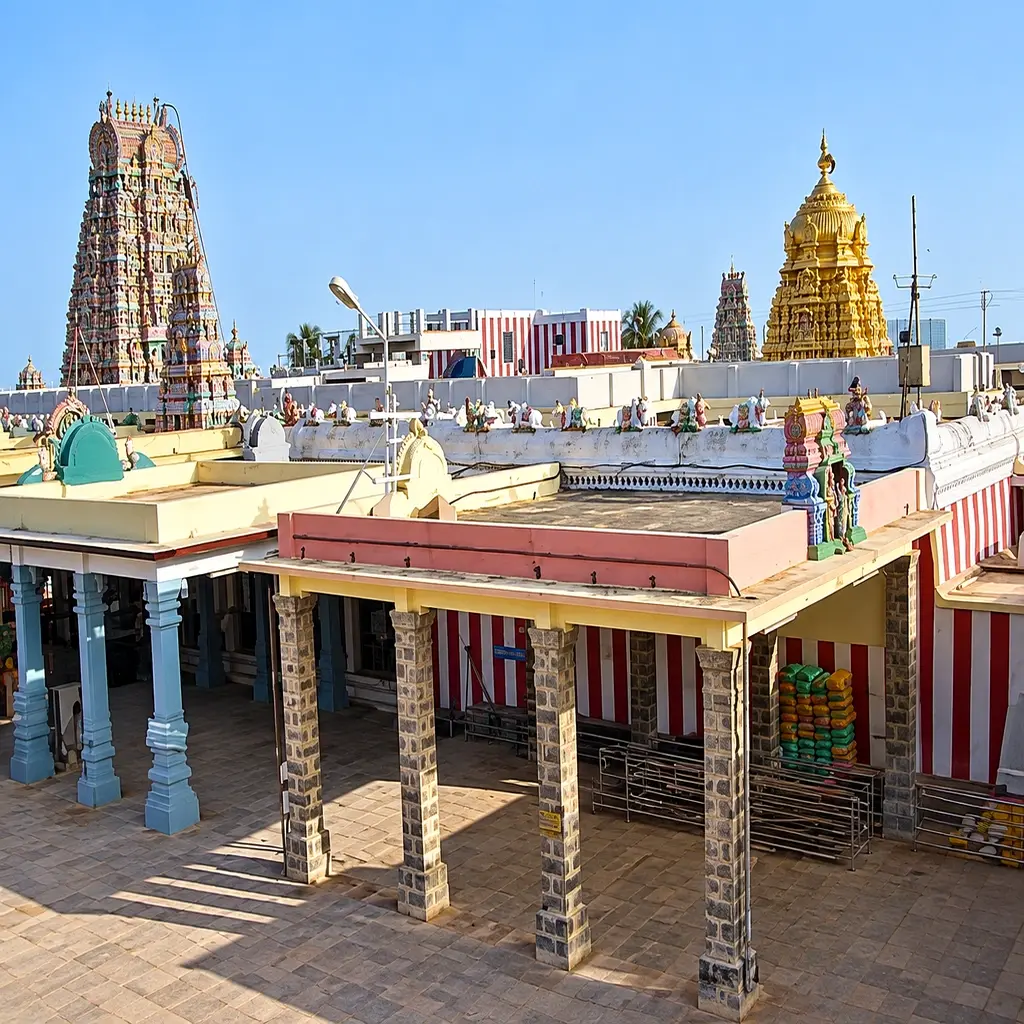
Arulmigu Dhandayuthapani Swamy Temple
அருள்மிகு தண்டாயுதபாணி சுவாமி திருக்கோயில்
Lord Murugan · Palani, Tamil Nadu
Ancient
About the temple
The Third of the six sacred Arupadai Veedu abodes of Murugan; where Lord Murugan renounced all worldly possessions and retreated atop Sivagiri hill after the divine fruit contest; renowned for the Navapashana idol and the famed Palani Panchamirtham (GI Tagged). Traditional belief: Renunciation of ego, curing of incurable physical and chronic diseases through Panchamirtham and Abhisheka water, and attainment of spiritual liberation.
Temple information
- Darshan timings
- 05:30 – 21:30
- Best time to visit
- Early morning hours on mid-week non-festival days to experience a peaceful darshan atmosphere
Deity
Lord MuruganGoddess ValliGoddess Devasena
- Deity form
- Miraculous Navapashanam (amalgam of nine poisonous herbs synthesized into nectar) standing icon of Lord Murugan as an ascetic youth holding a danda (staff)
- Religious tradition
- Vedic Agamic Kaumara Tradition & Siddha Alchemy of Sage Bogar
- Sanskrit name
- श्री दण्डायुधपाणिस्वामि मन्दिरम्
- Also known as
- Palani Murugan Temple, Thiru Aavinankudi, Palani Hill Temple, Third Arupadai Veedu
Darshan hours
- Daily
- 05:30 AM - 09:30 PM
- Break timings
- Continuous darshan throughout the day; darshan paused momentarily during major abhishekas
- Special days
- Thaipusam, Panguni Uthiram, Vaikasi Visakam: 04:00 AM - 11:30 PM (Continuous Darshan)
- Festival timings
- Open 24 hours continuously during Thaipusam and Panguni festival peaks
Aarti & rituals
- Morning aarti
- 06:00 AM
- Midday aarti
- 12:00 PM
- Evening aarti
- 06:00 PM
- Night aarti
- 08:30 PM
- Special aarti days
- Every Kiruthigai, Tuesdays, Sashti, Thaipusam, Panguni Uthiram
- Ritual schedule
- Six daily major pujas and abhishekas, Thanga Ratham (Golden Chariot) procession nightly, Bogar Samadhi worship
- Pooja timings
- 06:00 AM - 12:30 PM, 04:00 PM - 08:30 PM
- Abhishek timings
- Viswaroopa Abhishekam (06:00 AM), Sandhi (08:00 AM), Uchikalam (12:00 PM), Sayarakshai (06:00 PM), Rakkalam (08:00 PM)
- Special poojas
- Available
- Online pooja booking
- Yes
History & heritage
- Historical period
- Ancient
- Built by
- Consecrated by Sage Bogar; hilltop stone flight and prakaras built by Chera King Cheraman Perumal and Pandya kings
- Architect / builder
- Traditional Kongu and Pandya royal sthapathis
- Construction materials
- Solid dressed granite stone masonry, gold-plated vimana dome, ropeway, and winch track systems
- Historical events
- Sage Bogar crafted the Navapashanam deity using nine secret herbal minerals to bestow immortality upon mankind; king Cheraman Perumal was directed by Murugan in a dream to uncover the hidden deity
- Renovations
- Continually modernized by Tamil Nadu HR&CE Department with high-speed haulage winches, passenger ropeway, and gold-plated Vimana
- Archaeological importance
- Epigraphical records from Chera, Chola, and Pandya monarchs detailing village donations and perpetual ghee lamps
- Legends
- Sage Narada brought a divine fruit of wisdom (Gnana Pazham); Shiva and Parvati held a contest around the cosmos; Ganesha won by circumambulating his parents; Murugan left Mount Kailash in anger and settled on Sivagiri hill as "Pazham-Nee" (You are the Fruit)
- Inscriptions
- More than 50 inscriptions in Tamil dating from the 8th to 16th centuries recording royal endowments
Architecture
- Architectural style
- Dravidian
- Architectural period
- Ancient foundations with 8th - 16th Century CE structural expansions
- Structure
- Hilltop walled fortress temple standing atop a 450-foot hill reached by 693 steps, ropeway, and winch tracks, with vast foothill complexes at Aavinankudi
- Floors
- 1
- Gopuram
- Stepped stone Vimana tower above the sanctum completely covered in pure gold plate, and imposing entrance gopurams
- Mandapa
- Spacious pillared Navaranga and circumambulatory corridors supported by monolithic granite pillars with relief sculptures of Murugan
- Sculptural features
- The venerated Navapashana idol of Dhandayuthapani; golden chariot (Thanga Ratham); rock-cut shrine of Sage Bogar Samadhi; granite Nandi and Mayil (Peacock)
- Artistic elements
- Gold-plated kalashas, embossed silver doorframes, traditional hanging brass lamps, and diamond-studded Vel
- Construction technique
- Interlocking monolithic granite masonry anchored onto solid Precambrian hill bedrock
- Unique features
- The Navapashana deity synthesized from nine poisonous herbs by Sage Bogar; the GI-tagged Palani Panchamirtham made of five natural ingredients without artificial preservatives
Festivals & events
- Festival calendar
- Thai month Poosam (January/February), Panguni Uthiram (March/April)
- Special celebration days
- Every Kiruthigai, Tuesdays, Sashti, Sundays
- Cultural events
- Traditional Kavadi dance, Kavadi attam, classical Carnatic vocal concerts, and Nadaswaram festivals during Thaipusam
- Annual events
- The monumental Thaipusam and Panguni Uthiram Rathotsavams with millions carrying Pal-Kavadi and Mayil-Kavadi
- Peak crowd season
- December to April (Thaipusam, Panguni, and Sabarimala pilgrimage seasons)
Visitor information
- ✓ Parking
- ✓ Elevator
- ✓ Restrooms
- ✓ Drinking water
- ✓ Shoe keeping
- ✓ Prasadam counter
- Dress code
- Traditional
- Best time to visit
- Early morning hours on mid-week non-festival days to experience a peaceful darshan atmosphere
- Parking capacity
- 100+ Vehicles
- Parking fees
- Approx. 20-50 INR
- Donation counters
- Yes
- Donation methods
- Cash, UPI, Bank Transfer
- Prasadam
- Vibhuti/Kumkum.