
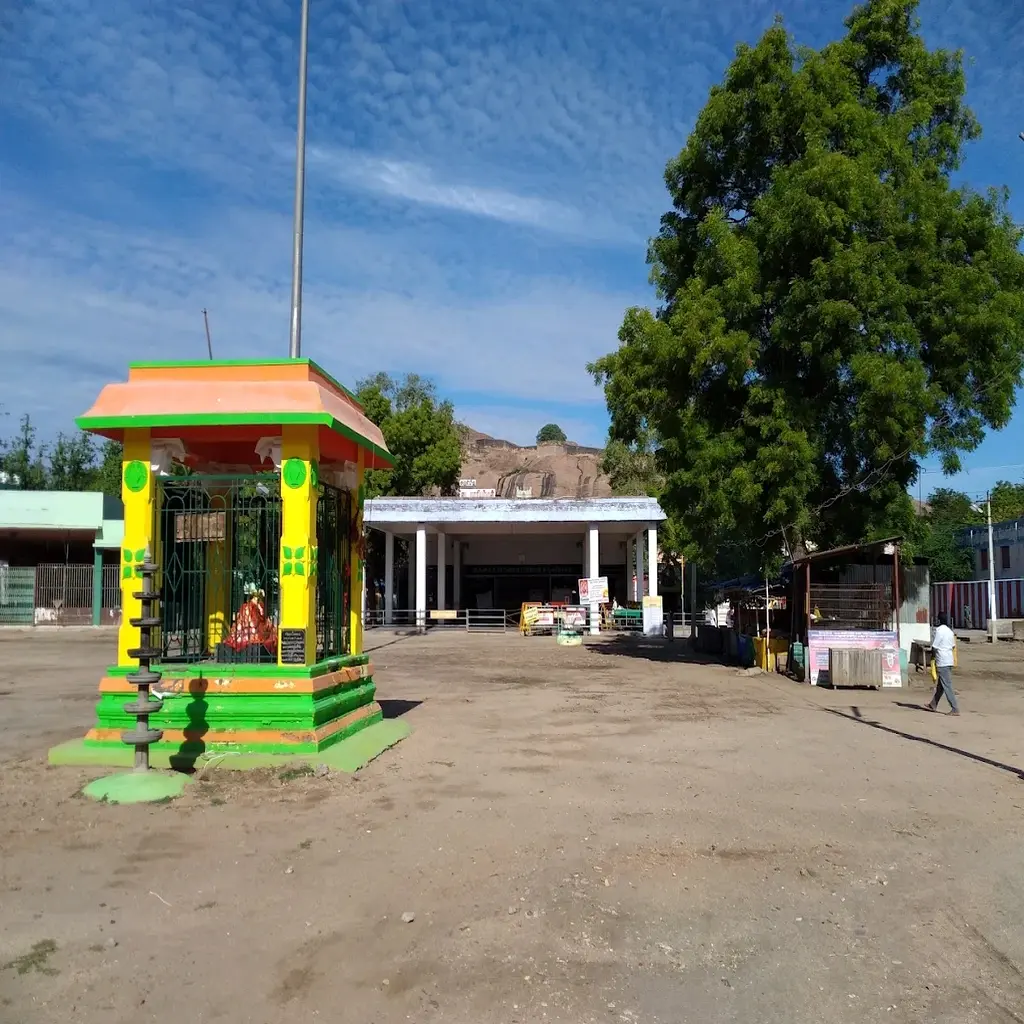
Arulmigu Kottai Mariamman Temple
அருள்மிகு கோட்டை மாரியம்மன் திருக்கோயில்
Goddess Mariamman · Dindigul, Tamil Nadu
Ancient
About the temple
The historical guardian deity of the Dindigul Rock Fort and the city; established by military commanders at the foothill of the historic fort; famous for the 20-day annual Masi festival where millions take vows of fire-pot carrying (Agnichatti) and flower-showering (Pookkuzhi). Traditional belief: Cures smallpox, chickenpox, and acute fevers; protects children from evil eye; resolves marriage obstacles, and brings agricultural rain.
Temple information
- Darshan timings
- 06:00 – 21:00
- Established
- 18
- Best time to visit
- Early morning hours on mid-week non-festival days to experience a peaceful darshan atmosphere
Deity
Goddess Mariamman · மாரியம்மன்Ganesha Family
- Deity form
- Ancient seated stone vigraha of Goddess Mariamman holding Trishula, sword, Damaru, and kapala, adorned with dazzling gold and diamond armor
- Religious tradition
- Agamic Shakta Tradition & Kongu/Pandya Folk-Classical Heritage
- Sanskrit name
- श्री दुर्गमारियम्बा मन्दिरम्
- Also known as
- Dindigul Kottai Mariamman Temple, Fort Mariamman Temple, Dindigul Amman Koil
Darshan hours
- Daily
- 06:00 AM - 12:30 PM, 04:30 PM - 09:00 PM
- Break timings
- 12:30 PM - 04:30 PM (Monday to Thursday)
- Special days
- Masi Festival (20 Days), Navaratri, Aadi Fridays: 04:00 AM - 11:30 PM (Continuous Darshan)
- Festival timings
- Open continuously till 11:30 PM during Masi festival days
Aarti & rituals
- Morning aarti
- 06:30 AM
- Midday aarti
- 12:00 PM
- Evening aarti
- 06:00 PM
- Night aarti
- 08:30 PM
- Special aarti days
- Every Friday, Tuesday, Masi festival days, Aadi Fridays, New Moon days
- Ritual schedule
- Nitya Chatukkala Puja, Sahasra Kumkumarchana, Agnichatti procession, Pookkuzhi (fire-walking), Golden Chariot procession
- Pooja timings
- 06:00 AM - 12:30 PM, 04:30 PM - 08:30 PM
- Abhishek timings
- 06:30 AM - 08:30 AM (Special Abhishekam to Ambal on Fridays and Tuesdays)
- Special poojas
- Available
- Online pooja booking
- No
History & heritage
- Historical period
- Ancient
- Built by
- Soldiers of the Dindigul Fort garrison; expanded by Dindigul merchant guilds and Tamil Nadu HR&CE Department
- Architect / builder
- Traditional Tamil stone sthapathis
- Construction materials
- Solid dressed granite stone base, brick-lime soaring Rajagopuram, gold-plated kalashas, silver chariot
- Historical events
- Tipu Sultan’s army commanders worshipped here for military success; the temple became the central civic sanctuary of Dindigul city
- Renovations
- Extensively modernized with a grand new seven-tiered Rajagopuram, air-conditioned queue mandapams, and gold vimanam
- Archaeological importance
- Crucial cultural monument representing the military and civic history of the 18th-century Dindigul Rock Fort
- Legends
- The Goddess appeared to the fort commanders, promising that as long as her altar was honored at the foot of the rock, Dindigul would remain unconquerable and safe from famine
- Inscriptions
- Commemorative plaques detailing endowments by local merchants and civic elders of Dindigul
Architecture
- Architectural style
- Dravidian
- Architectural period
- 18th Century foundations with 20th - 21st Century modern expansions
- Structure
- Dense urban walled temple complex with seven-tiered entrance Rajagopuram, pillared navaranga, inner sanctum, and chariot shelter
- Floors
- 1
- Gopuram
- Soaring seven-tiered 80-foot entrance Rajagopuram embellished with colorful stucco sculptures depicting Shakta legends and Durga triumphs
- Mandapa
- Spacious Mukhamandapa supported by polished granite pillars depicting Shakti devatas and guardian warriors
- Sculptural features
- Ancient stone murti of Goddess Kottai Mariamman; golden chariot (Thanga Ratham); silver Kavacham; shrines of Vinayaka and Murugan
- Artistic elements
- Intricate ceiling floral patterns, embossed silver sanctum frames, gold-plated kalashas, and brass oil lamps
- Construction technique
- Interlocking monolithic granite block masonry adapted for heavy urban pilgrim footfall
- Unique features
- The famous 20-day Masi festival where over 500,000 devotees carry sacred fire-pots (Agnichatti) and walk across burning coals (Pookkuzhi)
Festivals & events
- Festival calendar
- Masi month (February/March Masi Festival), Ashwayuja Navaratri
- Special celebration days
- Every Friday, Tuesday, New Moon day (Amavasya)
- Cultural events
- Folk dance, Nadaswaram, Carnatic classical concerts, and dramatic re-enactments during the annual festival
- Annual events
- The monumental Masi festival featuring Agnichatti and Pookkuzhi drawing over 500,000 devotees
- Peak crowd season
- February to March (Masi festival) and July to August (Aadi month)
Visitor information
- ✓ Parking
- ✓ Restrooms
- ✓ Drinking water
- ✓ Shoe keeping
- ✓ Prasadam counter
- Dress code
- Traditional
- Best time to visit
- Early morning hours on mid-week non-festival days to experience a peaceful darshan atmosphere
- Parking capacity
- 100+ Vehicles
- Parking fees
- Approx. 20-50 INR
- Donation counters
- Yes
- Donation methods
- Cash, UPI, Bank Transfer
- Prasadam
- Vibhuti/Kumkum.