
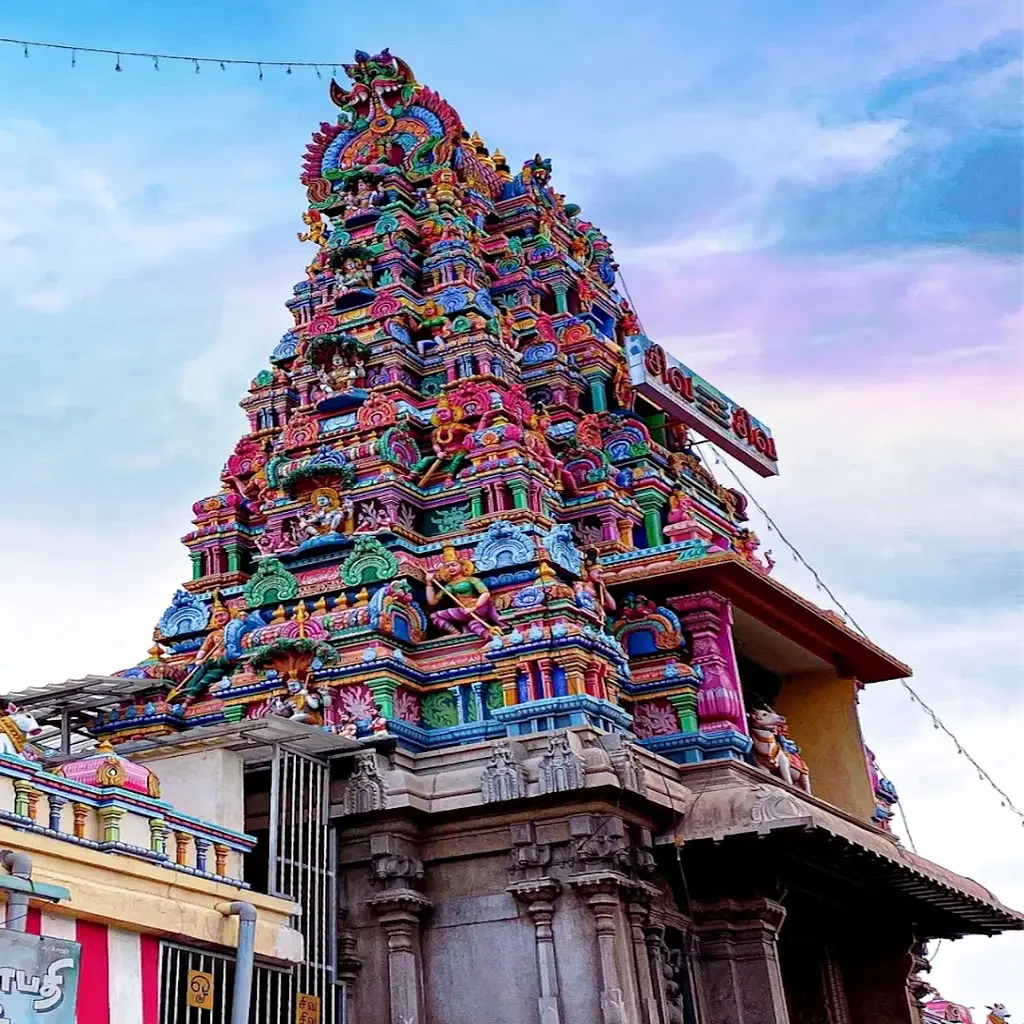
Abirami Amman Temple
ஸ்ரீ காளஹஸ்தீஸ்வரர் அபிராமி அம்மன் திருக்கோயில்
Lord Shiva · Dindigul, Tamil Nadu
Ancient
About the temple
The historic central Shiva temple of Dindigul city; revered as the Kalahasti of the South; home to the compassionate Goddess Abirami Amman whose grace brings matrimonial harmony, health, and peace; celebrated for its grand Navaratri Kolu and Pradosham gatherings. Traditional belief: Removal of Rahu-Ketu and planetary doshas (Kalahasteeswarar grace), blessing of long-lived matrimony (Mangalya Bhagyam), and spiritual wisdom.
Temple information
- Darshan timings
- 06:00 – 20:30
- Established
- 14
- Best time to visit
- Early morning hours on mid-week non-festival days to experience a peaceful darshan atmosphere
Deity
Lord Shiva · ଶିବ (Shiva)Ganesha Family
- Deity form
- Ancient Swayambhu Shiva Lingam inside inner sanctum; radiant standing stone murti of Goddess Abirami holding lotus and varada mudra
- Religious tradition
- Agamic Shaiva Tradition & Abirami Shakta Heritage
- Sanskrit name
- श्री कालहस्तीश्वर अभिरामी मन्दिरम्
- Also known as
- Kalahasteeswarar Gnanambika Temple, Dindigul Shiva Temple, Abirami Amman Gudi Dindigul
Darshan hours
- Daily
- 06:00 AM - 01:00 PM, 04:00 PM - 09:00 PM
- Break timings
- 12:30 PM - 04:30 PM
- Special days
- Maha Shivaratri, Navaratri, Arudra Darshanam: 05:00 AM - 10:30 PM
- Festival timings
- Open till 10:30 PM on Maha Shivaratri and festival days
Aarti & rituals
- Morning aarti
- 07:00 AM
- Midday aarti
- 12:00 PM
- Evening aarti
- 06:00 PM
- Night aarti
- 8:15 PM
- Special aarti days
- Mondays, Pradosham, Maha Shivaratri, Fridays for Abirami
- Ritual schedule
- Nitya Chatukkala Puja, Rudrabhishekam, Abirami Sahasranamarchana, Rahu-Ketu Parihara, Sandhya Deeparadhana
- Pooja timings
- 06:30 AM - 12:00 PM, 04:30 PM - 08:00 PM
- Abhishek timings
- 07:00 AM - 08:30 AM
- Special poojas
- Available
- Online pooja booking
- No
History & heritage
- Historical period
- Ancient
- Built by
- Vijayanagara rulers; expanded by Madurai Nayaka kings and local Chettiar philanthropists
- Architect / builder
- Traditional Tamil stone sthapathis
- Construction materials
- Solid dressed dark granite, brick-lime vimana towers, brass flagstaff
- Historical events
- Built to provide a premier Kalahasti-style Rahu-Ketu parihara sanctuary for the Kongu-Pandya border trade routes
- Renovations
- Renovated under Tamil Nadu HR&CE Department with new Rajagopuram painting and marble flooring
- Archaeological importance
- Heritage temple serving as the traditional Shaiva civic anchor of Dindigul
- Legends
- Lord Shiva manifests as the Lord of Kalahasti to grant liberation from serpent curses, while Goddess Abirami bestows eternal auspiciousness
- Inscriptions
- Stone records preserved in the temple detailing endowments made by Nayaka officers and trade guilds
Architecture
- Architectural style
- Dravidian
- Architectural period
- 15th - 17th Century CE
- Structure
- Walled urban temple complex with five-tiered entrance Rajagopuram, pillared navaranga, inner sanctum, and separate Abirami Amman shrine
- Floors
- 1
- Gopuram
- Five-tiered entrance Rajagopuram embellished with stucco sculptures of Shaivite puranic legends
- Mandapa
- Pillared Navaranga hall supported by square granite columns depicting yalis, dancers, and Shaiva saints
- Sculptural features
- Ancient stone Shiva Lingam; radiant standing stone murti of Goddess Abirami Amman; carved stone Nandi; Dakshinamurti in wall niche
- Artistic elements
- Intricate ceiling medallions, embossed silver sanctum frames, and brass oil lamps
- Construction technique
- Interlocking monolithic granite block masonry of durable Vijayanagara design
- Unique features
- Dual consecration as Kalahasteeswarar for planetary dosha parihara and Abirami Amman for matrimonial blessings
Festivals & events
- Festival calendar
- Ashwayuja Navaratri, Magha Bahula Chaturdashi (Shivaratri)
- Special celebration days
- Every Monday, Pradosham, Fridays for Abirami
- Cultural events
- Devotional bhajans, Carnatic music concerts, and Harikatha during Navaratri and Shivaratri
- Annual events
- Maha Shivaratri celebrations and annual car festival
- Peak crowd season
- October to February and during Navaratri
Visitor information
- ✓ Parking
- ✓ Restrooms
- ✓ Drinking water
- ✓ Shoe keeping
- ✓ Prasadam counter
- Dress code
- Traditional
- Best time to visit
- Early morning hours on mid-week non-festival days to experience a peaceful darshan atmosphere
- Parking capacity
- 100+ Vehicles
- Parking fees
- Approx. 20-50 INR
- Donation counters
- Yes
- Donation methods
- Cash, UPI, Bank Transfer
- Prasadam
- Vibhuti/Kumkum.