
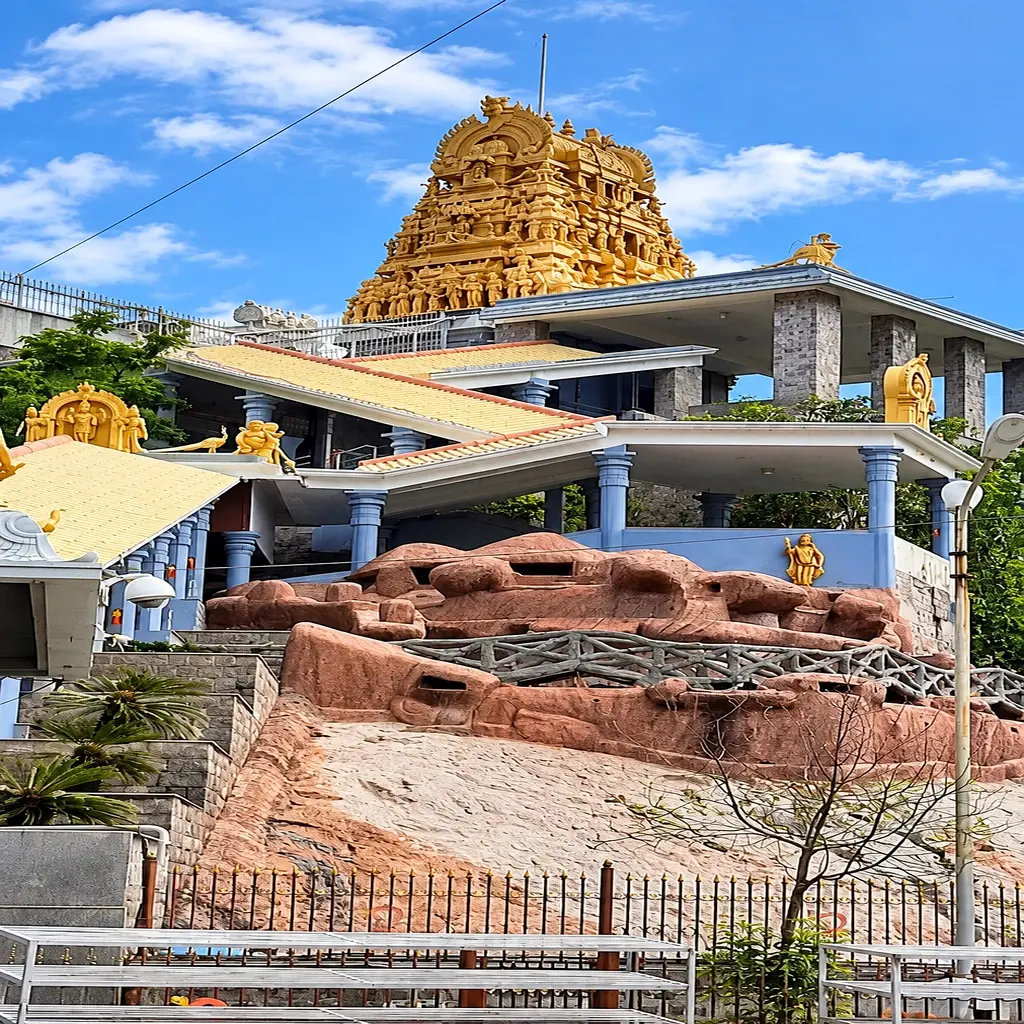
Arulmigu Velayuthasamy Temple
அருள்மிகு வேலாயுதசுவாமி திருக்கோயில்
Lord Murugan · Erode, Tamil Nadu
Ancient
About the temple
The guardian hilltop deity of Erode city; situated atop a scenic 150-foot hillock right on the Erode-Perundurai highway; praised by Saint Arunagirinathar in his Tiruppugazh hymns; famous for the miraculous golden lamp and panoramic evening views. Traditional belief: Removal of speech impediments, success in trade and business ventures, freedom from debts, and relief from chronic illnesses.
Temple information
- Darshan timings
- 06:00 – 20:30
- Established
- 14
- Best time to visit
- Early morning hours on mid-week non-festival days to experience a peaceful darshan atmosphere
Deity
Lord MuruganGoddess ValliGoddess DevasenaGanesha Family
- Deity form
- Radiant stone idol of Lord Murugan holding the victorious spear (Vel) standing atop the hillock, accompanied by Valli and Devasena
- Religious tradition
- Vedic Agamic Kaumara Tradition & Kongu Hilltop Heritage
- Sanskrit name
- श्री वेलायुधस्वामी मन्दिरम्
- Also known as
- Velayuthaswamy Temple Thindal, Thindalmalai Murugan Gudi, Erode Hill Murugan Temple
Darshan hours
- Daily
- 06:00 AM - 12:30 PM, 04:30 PM - 08:30 PM
- Break timings
- 12:30 PM - 04:30 PM (Monday to Thursday)
- Special days
- Thaipusam, Panguni Uthiram, Skanda Sashti: 04:30 AM - 11:00 PM
- Festival timings
- Open continuously till 11:00 PM during Thaipusam and major festival days
Aarti & rituals
- Morning aarti
- 06:30 AM
- Midday aarti
- 12:00 PM
- Evening aarti
- 06:00 PM
- Night aarti
- 8:15 PM
- Special aarti days
- Every Kiruthigai, Tuesdays, Sashti, Thaipusam, Panguni Uthiram
- Ritual schedule
- Nitya Chatukkala Puja, Ksheerabhishekam, Sandal paste Alankara, Golden Chariot (Thanga Ratham) procession, Deeparadhana
- Pooja timings
- 06:30 AM - 12:00 PM, 04:30 PM - 08:15 PM
- Abhishek timings
- 07:00 AM - 08:30 AM (Special Abhishekam on Tuesdays and Kiruthigai)
- Special poojas
- Available
- Online pooja booking
- No
History & heritage
- Historical period
- Ancient
- Built by
- Local Gounder chieftains under Vijayanagara suzerainty; developed into a monumental temple by Erode industrialists
- Architect / builder
- Traditional Tamil stone sthapathis
- Construction materials
- Solid dressed dark granite stone masonry, brick-lime vimana, 150 stone steps
- Historical events
- Saint Arunagirinathar visited this hill and composed hymns celebrating the grace of Lord Velayuthaswamy
- Renovations
- Extensively modernized under Tamil Nadu HR&CE Department with lift facilities, covered queue mandapams, and gold-plated vimanam
- Archaeological importance
- Heritage hill temple preserving authentic medieval Kongu stone carvings and Tiruppugazh associations
- Legends
- Lord Murugan manifested atop the rocky hill to protect the travelers crossing between Kongu Nadu and Mysore
- Inscriptions
- Stone records preserved on the temple base detailing endowments made by town merchant guilds and textile industrialists
Architecture
- Architectural style
- Dravidian
- Architectural period
- 14th Century foundations with 20th Century CE modern expansions
- Structure
- Hilltop stone temple complex reached by 150 gentle steps or passenger lift, with entrance gopuram, pillared navaranga, and viewpoint parapets
- Floors
- 1
- Gopuram
- Stepped Dravidian stone and stucco Rajagopuram adorned with colorful sculptures of Murugan’s Arupadaiveedu legends
- Mandapa
- Spacious Mukhamandapa supported by polished granite columns depicting yalis, dancers, and guardian devatas
- Sculptural features
- Radiant standing stone murti of Lord Velayuthaswamy holding Vel; beautiful standing bronze icons of Valli and Devasena; carved stone peacock (Mayil)
- Artistic elements
- Intricate ceiling floral patterns, embossed silver sanctum frames, gold-plated kalashas, and golden chariot
- Construction technique
- Interlocking monolithic granite block masonry anchored on a natural basalt hill spur
- Unique features
- The dramatic hilltop position overlooking the city of Erode, passenger elevator facility, and the golden chariot (Thanga Ratham)
Festivals & events
- Festival calendar
- Thai month Poosam (January/February), Panguni Uthiram
- Special celebration days
- Every Kiruthigai, Tuesdays, Sashti, Sundays
- Cultural events
- Classical Carnatic concerts, Bharatanatyam performances, and Kavadi dance processions during Thaipusam
- Annual events
- Thindalmalai Thaipusam Maha Rathotsavam and Float Festival (Teppotsavam) drawing over 100,000 devotees
- Peak crowd season
- October to February, every monthly Kiruthigai, and during summer school holidays
Visitor information
- ✓ Parking
- ✓ Restrooms
- ✓ Drinking water
- ✓ Shoe keeping
- ✓ Prasadam counter
- Dress code
- Traditional
- Best time to visit
- Early morning hours on mid-week non-festival days to experience a peaceful darshan atmosphere
- Parking capacity
- 100+ Vehicles
- Parking fees
- Approx. 20-50 INR
- Donation counters
- Yes
- Donation methods
- Cash, UPI, Bank Transfer
- Prasadam
- Vibhuti/Kumkum.