
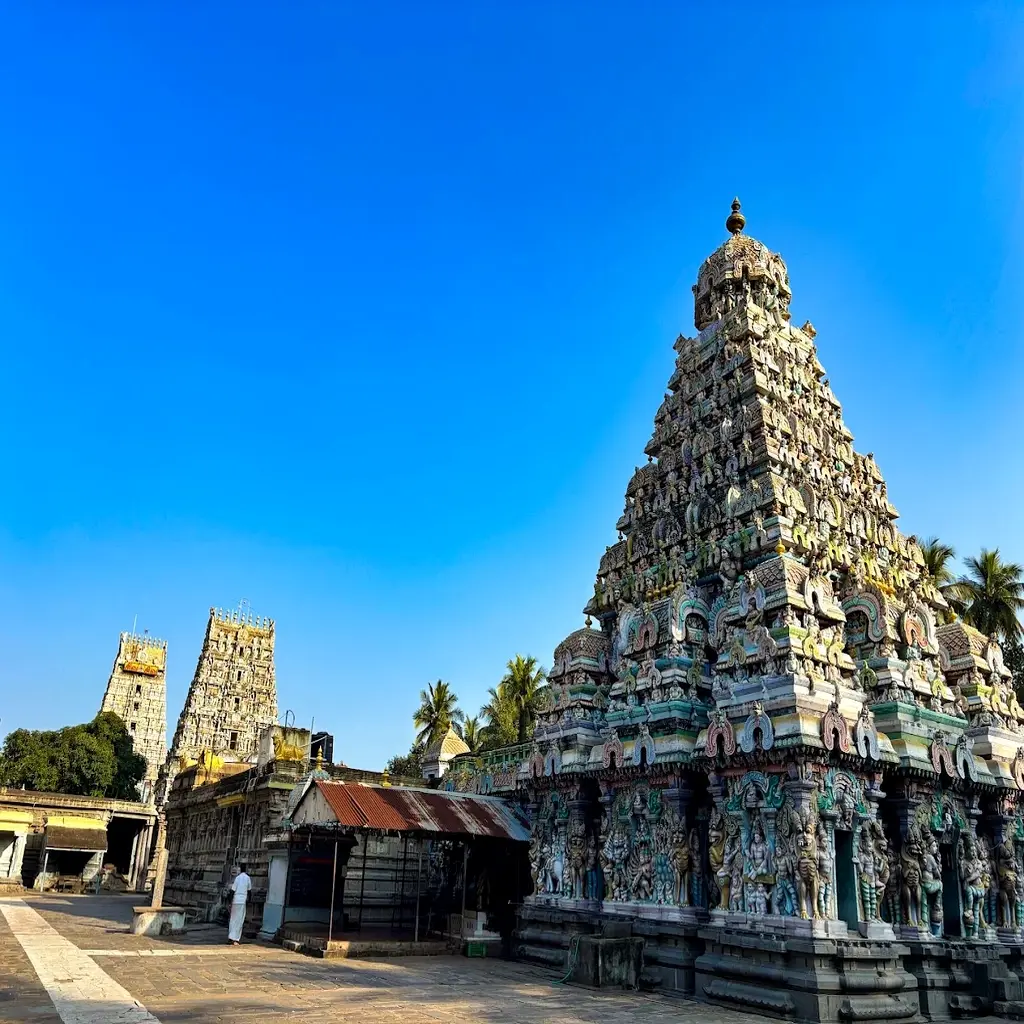
Arulmigu Veeratteswarar Temple
அருள்மிகு வீரட்டேஸ்வரர் திருக்கோயில்
Lord Shiva · Tirukoilur, Tamil Nadu
Ancient
About the temple
One of the sacred Eight Heroic Abodes (Ashta Veerattanam) of Lord Shiva; holy site where Shiva vanquished the demon of spiritual blindness, Andhakasura, with his trident; 21st Paadal Petra Sthalam of Nadu Naadu; historic capital of the philanthropic Malayaman dynasty ruled by King Malayaman Thirumudi Kari. Traditional belief: Complete destruction of spiritual ignorance (Andhaka), removal of acute eye and vision disorders, protection from enemies, and grant of liberation.
Temple information
- Darshan timings
- 06:00 – 20:30
- Established
- 7
- Best time to visit
- Early morning hours on mid-week non-festival days to experience a peaceful darshan atmosphere
Deity
Lord Shiva · ଶିବ (Shiva)Ganesha FamilyLord Murugan
- Deity form
- Ancient Swayambhu Shiva Lingam inside inner sanctum; world-famous bronze and stone icon of Lord Shiva spearing demon Andhakasura
- Religious tradition
- Vedic Agamic Shaiva Siddhanta & Andhakasura Heroic Legend
- Sanskrit name
- श्री वीरट्टेश्वर मन्दिरम्
- Also known as
- Tirukoilur Veerattanam, Ashta Veerattana Kshetra Tirukoilur, Andhakasura Samhara Temple
Darshan hours
- Daily
- 06:00 AM - 12:30 PM, 04:00 PM - 08:30 PM
- Break timings
- 12:30 PM - 04:00 PM
- Special days
- Maha Shivaratri, Masi Brahmotsavam: 04:30 AM - 11:30 PM
- Festival timings
- Open till 11:30 PM on Maha Shivaratri and festival days
Aarti & rituals
- Morning aarti
- 07:00 AM
- Midday aarti
- 12:00 PM
- Evening aarti
- 06:00 PM
- Night aarti
- 07:45 PM
- Special aarti days
- Every Monday, Pradosham, Maha Shivaratri, Masi Brahmotsavam
- Ritual schedule
- Nitya Chatukkala Puja, Rudrabhisheka, Andhakasura Samhara Utsavam, Sandhya Deeparadhana
- Pooja timings
- 06:30 AM - 12:00 PM, 04:30 PM - 08:00 PM
- Abhishek timings
- 07:00 AM - 08:30 AM
- Special poojas
- Available
- Online pooja booking
- No
History & heritage
- Historical period
- Ancient
- Built by
- Malayaman Chieftains and Chola Kings (Rajaraja I and Rajendra I)
- Architect / builder
- Master traditional Chola stone sculptors
- Construction materials
- Solid dressed dark granite stone blocks, brick-lime Rajagopuram, brass flagstaff
- Historical events
- Celebrated in Thevaram hymns by Appar and Sambandar; Malayaman Thirumudi Kari, one of the seven great philanthropists (Kadai Ezhu Vallalgal), ruled from this fort
- Renovations
- Protected and renovated under Tamil Nadu HR&CE Department with new granite stone pathways and restored temple tank
- Archaeological importance
- Crucial epigraphical monument preserving ancient inscriptions of Rajaraja Chola and the Malayaman dynasty
- Legends
- Lord Shiva pierced the demon of darkness Andhakasura with his Trishula; to prevent his blood drops from creating more demons, Goddess Bhairavi swallowed the blood
- Inscriptions
- More than 35 stone inscriptions in Tamil dating from the 10th to 15th century recording grants by Chola, Pandya, and Vijayanagara kings
Architecture
- Architectural style
- Dravidian
- Architectural period
- Circa 980 - 1020 CE
- Structure
- Walled stone temple complex with seven-tiered entrance Rajagopuram, pillared navaranga, inner sanctum, and Sivanandavalli shrine
- Floors
- 1
- Gopuram
- Seven-tiered 80-foot entrance Rajagopuram decorated with colorful stucco figures of Andhakasura Samharam and Shaivite legends
- Mandapa
- Pillared Mukhamandapa and Mahamandapa supported by massive square granite columns depicting yalis and Nayanmar saints
- Sculptural features
- Ancient stone Shiva Lingam; awe-inspiring bronze idol of Andhakasura Samhara Murti; graceful Sivanandavalli Amman; seated stone Nandi
- Artistic elements
- Intricate makara toranas, deep-cut devakoshta niches, and embossed silver sanctum frames
- Construction technique
- Dry-stone interlocking granite block masonry of durable Chola execution
- Unique features
- One of the eight sacred Ashta Veerattana shrines of Shiva, representing the cosmic triumph over spiritual darkness and blindness
Festivals & events
- Festival calendar
- Masi month (February/March Brahmotsavam), Magha Bahula Chaturdashi
- Special celebration days
- Every Monday, Pradosham, New Moon days
- Cultural events
- Devotional bhajans, Thevaram parayanam, and classical music during Masi festival
- Annual events
- Veeratteswarar Maha Rathotsavam and Andhakasura Samhara festival drawing over 50,000 devotees
- Peak crowd season
- October to February and during Maha Shivaratri
Visitor information
- ✓ Parking
- ✓ Restrooms
- ✓ Drinking water
- ✓ Shoe keeping
- ✓ Prasadam counter
- Dress code
- Traditional
- Best time to visit
- Early morning hours on mid-week non-festival days to experience a peaceful darshan atmosphere
- Parking capacity
- 20-30 vehicles
- Parking fees
- Approx. 20-50 INR
- Donation counters
- Yes
- Donation methods
- Cash, UPI, Bank Transfer
- Prasadam
- Vibhuti/Kumkum.