
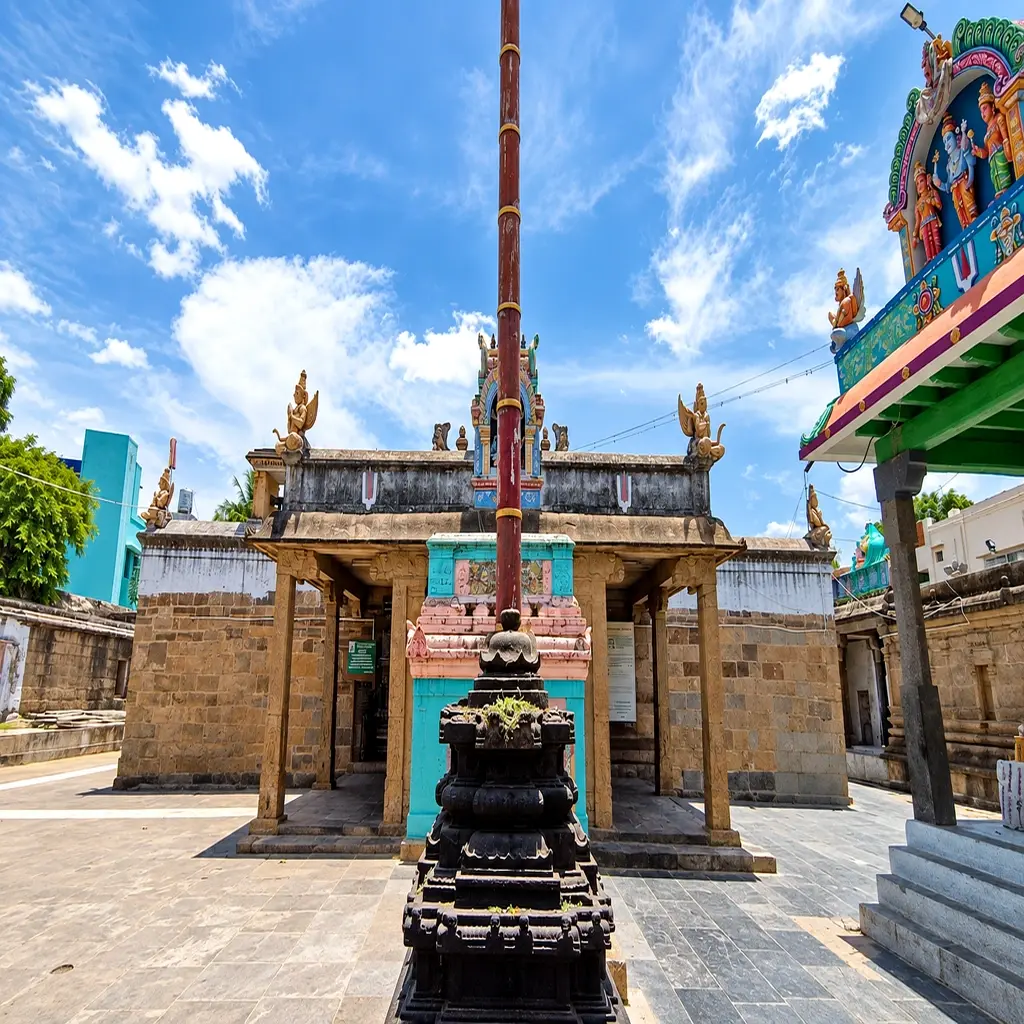
Ulagalantha Perumal Temple
உலகளந்த பெருமாள் திருக்கோயில்
Trivikrama · Kanchipuram, Tamil Nadu
Ancient
About the temple
One of the most extraordinary Divya Desams in India; houses four distinct 108 Divya Desams within a single temple compound (Thiru Ooragam, Thiru Karagam, Thiru Kaarvaanam, and Thiru Neeragam); features the colossal 35-foot giant Trivikrama idol measuring the heavens; where Lord Vishnu appeared in miniature form to blind King Mahabali. Traditional belief: Immediate neutralization of pride and ego, relief from severe land and property litigations, grant of immense cosmic perspective, and liberation.
Temple information
- Darshan timings
- 06:00 – 20:30
- Established
- 8
- Best time to visit
- Early morning hours on mid-week non-festival days to experience a peaceful darshan atmosphere
Deity
TrivikramaThiruvappana
- Deity form
- Colossal 35-foot tall monolithic stone/stucco icon of Lord Trivikrama raising his left leg to the sky with right foot planted on Mahabali, holding two fingers raised indicating two paces
- Religious tradition
- Vedic Pancharatra Agamic Tradition & Four Divya Desams in One Sannidhi
- Sanskrit name
- श्री त्रिविक्रम पेरुमाळ मन्दिरम्
- Also known as
- Kanchi Trivikrama Temple, Ooragam Divya Desam, Four-in-One Divya Desam Kanchipuram
Darshan hours
- Daily
- 06:00 AM - 12:00 PM, 04:30 PM - 08:30 PM
- Break timings
- 12:00 PM - 04:30 PM (Monday to Thursday)
- Special days
- Vaikunta Ekadashi, Vamana Jayanthi: 04:00 AM - 11:30 PM
- Festival timings
- Open continuously till 11:30 PM on Vaikunta Ekadashi and festival days
Aarti & rituals
- Morning aarti
- 07:00 AM
- Midday aarti
- 11:45 AM
- Evening aarti
- 06:00 PM
- Night aarti
- 8:15 PM
- Special aarti days
- Saturdays, Ekadashi, Vaikunta Ekadashi, Purattasi Saturdays
- Ritual schedule
- Nitya Thiruvaradhana to all four Divya Desams, Thulasi Archana, Divya Prabandham Parayanam, Sahasranamarchana, Mangala Harathi
- Pooja timings
- Since Moolavar is colossal 35-foot stucco idol, Thirumanjanam is performed with natural oils (Thailakkappu) periodically, and daily to bronze Utsava deity at 07:00 AM
- Abhishek timings
- Since Moolavar is colossal 35-foot stucco idol, Thirumanjanam is performed with natural oils (Thailakkappu) periodically, and daily to bronze Utsava deity at 07:00 AM
- Special poojas
- Available
- Online pooja booking
- No
History & heritage
- Historical period
- Ancient
- Built by
- Pallavas of Kanchi (King Nandivarman II); expanded by Medieval Cholas (Raja Raja I) and Vijayanagara Emperors
- Architect / builder
- Master traditional royal sthapathis of the Pallava and Chola courts
- Construction materials
- Solid dressed dark granite, stucco-lime colossal 35-foot deity, brick-mortar Rajagopuram
- Historical events
- Sanctified in the pasurams of Thirumazhisai Alvar and Thirumangai Alvar; King Mahabali requested the Lord to appear in aniconic serpent form as well, leading to the Ooragathan shrine
- Renovations
- Protected and renovated under Tamil Nadu HR&CE Department with new granite stone pathways, lighting, and Rajagopuram conservation
- Archaeological importance
- Crucial epigraphical monument preserving ancient Tamil inscriptions of Pallava King Nandivarman and Chola monarchs
- Legends
- Lord Vishnu grew into the cosmic Trivikrama form; his left leg reached Satyaloka where Lord Brahma washed his feet with Ganga water; two fingers raised indicate two paces taken
- Inscriptions
- More than 25 stone inscriptions in Tamil dating from the 8th to 15th century recording grants by Pallava, Chola, and Vijayanagara rulers
Architecture
- Architectural style
- Dravidian
- Architectural period
- 8th Century core with 11th - 15th Century CE expansions
- Structure
- Walled urban temple complex with three-tiered entrance Rajagopuram, soaring sanctum ceiling to house the 35-foot deity, and four separate Divya Desam chambers
- Floors
- 1
- Gopuram
- Three-tiered 50-foot entrance Rajagopuram adorned with stucco sculptures of Vamana Avatara, Trivikrama, and Alwars
- Mandapa
- Pillared Mahamandapa supported by monolithic granite columns depicting Dashavatara panels and Vaishnava yalis
- Sculptural features
- Awe-inspiring 35-foot tall monolithic stucco icon of Lord Trivikrama raising his left leg to heaven; the small serpent shrine of Ooragathan; stone Amirthavalli Thayar
- Artistic elements
- Intricate ceiling medallions, embossed silver altar frames, and traditional brass oil lamps
- Construction technique
- Interlocking monolithic granite block masonry combined with soaring timber-and-mortar vaulted roof
- Unique features
- Houses four separate 108 Divya Desams within one single compound (Ooragam, Karagam, Kaarvaanam, Neeragam), and the colossal 35-foot Trivikrama deity
Festivals & events
- Festival calendar
- Bhadrapada Shukla Dwadashi (Vamana Jayanthi), Margashirsha Shukla Ekadashi
- Special celebration days
- Every Saturday, Shukla Ekadashi, Purattasi Saturdays
- Cultural events
- Divya Prabandham goshti chanting, Carnatic music concerts, and Harikatha during festivals
- Annual events
- Ulagalanda Perumal Maha Rathotsavam drawing over 100,000 devotees across Tamil Nadu
- Peak crowd season
- October to March and during Vaikunta Ekadashi and Purattasi Saturdays
Visitor information
- ✓ Parking
- ✓ Restrooms
- ✓ Drinking water
- ✓ Shoe keeping
- ✓ Prasadam counter
- Dress code
- Traditional
- Best time to visit
- Early morning hours on mid-week non-festival days to experience a peaceful darshan atmosphere
- Parking capacity
- 50+ vehicles
- Parking fees
- Approx. 20-50 INR
- Donation counters
- Yes
- Donation methods
- Cash, UPI, Bank Transfer
- Prasadam
- Vibhuti/Kumkum.