
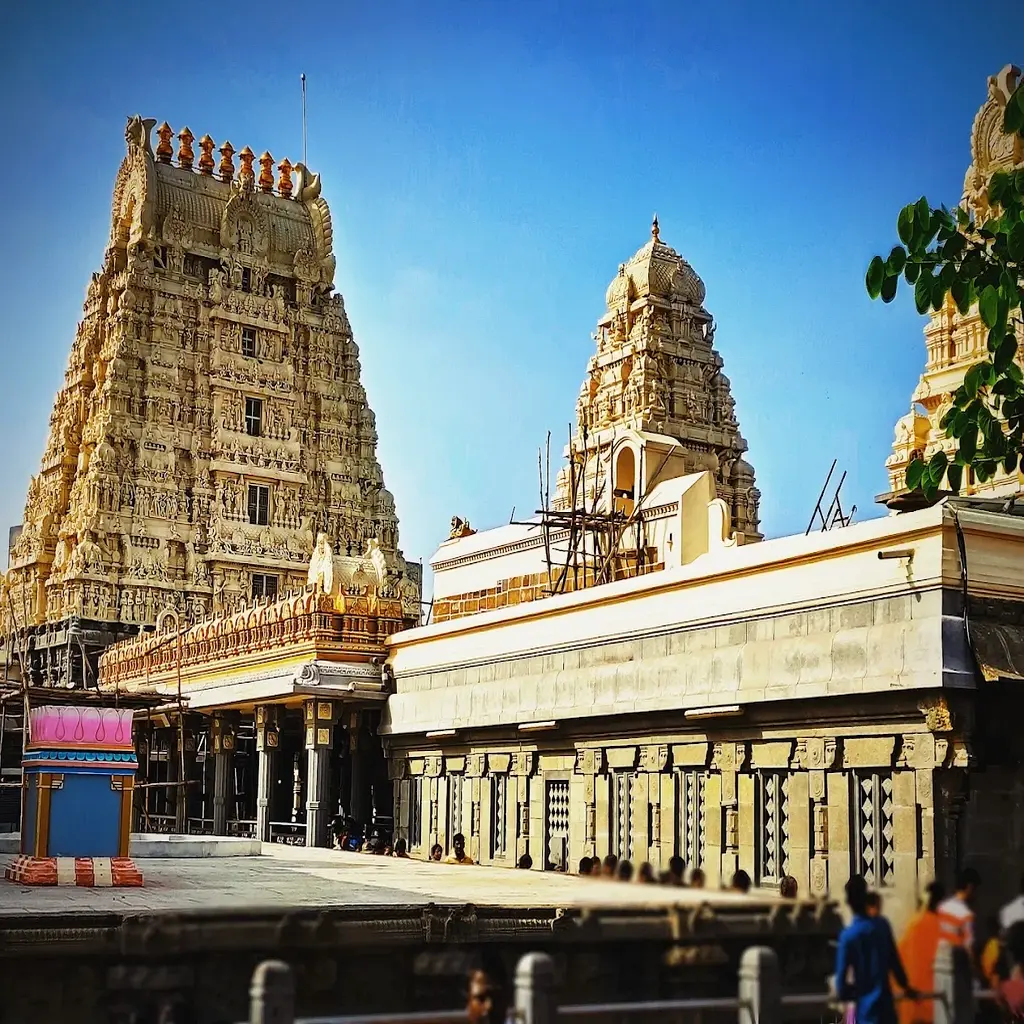
Sri Kanchi Kamakshi Amman Temple
ஸ்ரீ காஞ்சி காமாட்சி அம்மன் திருக்கோயில்
Goddess Kamakshi · Kanchipuram, Tamil Nadu
Ancient
About the temple
One of the foremost 51 Maha Shakti Peethams (Nabisthana / Navel Peetham); the supreme Shakta sanctuary of South India; unique city where no other Shiva temple in Kanchipuram has a separate Ambal shrine because Kamakshi’s presence encompasses all temples; where Adi Shankaracharya pacified the fierce deity by installing the Sri Chakra. Traditional belief: Supreme wish-fulfillment through her compassionate eyes (Kama-Akshi), grant of righteous progeny, matrimonial harmony, and liberation from rebirth.
Temple information
- Darshan timings
- 05:30 – 21:30
- Established
- 6
- Best time to visit
- Early morning hours on mid-week non-festival days to experience a peaceful darshan atmosphere
Deity
Goddess Kamakshi · देवी कामाक्षीSri ChakraGanesha Family
- Deity form
- Radiant seated stone vigraha of Goddess Kamakshi in padmasana holding sugarcane bow, flower arrows, pasha, and ankusha, with the consecrated Sri Yantra (Ardha Meru) at her lotus feet
- Religious tradition
- Vedic Sri Vidya Shakta Agamic Tradition established by Adi Shankaracharya
- Sanskrit name
- श्री काञ्ची कामाक्षी अम्बा मन्दिरम्
- Also known as
- Kanchi Kamakshi Temple, Nabisthana Shakti Peetham, Kamakoti Peetham Kanchipuram
Darshan hours
- Daily
- 05:30 AM - 12:30 PM, 04:00 PM - 09:30 PM
- Break timings
- 12:30 PM - 04:00 PM (Monday to Thursday)
- Special days
- Masi Brahmotsavam, Navaratri, Chitra Pournami: 04:00 AM - 11:30 PM (Continuous Darshan)
- Festival timings
- Open continuously till 11:30 PM during Navaratri and major festival days
Aarti & rituals
- Morning aarti
- 07:30 AM
- Midday aarti
- 12:00 PM
- Evening aarti
- 06:00 PM
- Night aarti
- 09:00 PM
- Special aarti days
- Every Friday, Tuesday, Purnima, Navaratri days, Masi Therottam
- Ritual schedule
- Nitya Arukala Puja, Sri Chakra Navavarana Puja, Sahasra Kumkumarchana, Suhasini Puja, Golden Chariot (Thanga Ratham) procession
- Pooja timings
- 06:00 AM - 12:30 PM, 04:30 PM - 09:00 PM
- Abhishek timings
- Abhishekam is not performed directly to the stone Kamakshi; it is performed to the consecrated Ardha-Meru Sri Chakra and Utsava deity at 06:00 AM, 11:00 AM, and 05:00 PM
- Special poojas
- Available
- Online pooja booking
- Via portal
History & heritage
- Historical period
- Ancient
- Built by
- Pallava Kings; enhanced by Chola Emperors (Kulothunga I) and Vijayanagara Emperors (Harihara II and Krishnadevaraya)
- Architect / builder
- Master traditional royal sthapathis of Tamil Nadu; spiritual leadership of Kanchi Kamakoti Peetham
- Construction materials
- Solid dressed dark granite stone masonry, pure gold-plated Vimana roof, brass flagstaff, sacred temple tank
- Historical events
- Jagadguru Adi Shankaracharya consecrated the Sri Chakra here and entered Mahasamadhi; recovery of the city’s spiritual peace; King Krishnadevaraya covered the Vimana in gold in 1516 CE
- Renovations
- Punarprathishta and massive Swarna Bandhana Mahakumbhabhishekam completed under the divine presence of the Kanchi Sankaracharyas with pure gold vimana renovation
- Archaeological importance
- Priceless living Shakti Peetham monument preserving ancient Chola, Vijayanagara, and Pallava epigraphs
- Legends
- Goddess Kamakshi performed intense penance under a mango tree on the banks of Vegavathi river, making a Lingam of sand (Prithvi Lingam) to unite with Lord Shiva
- Inscriptions
- More than 40 monumental stone inscriptions in Tamil, Telugu, and Sanskrit detailing royal donations of gold, jewels, and villages by Chola and Vijayanagara kings
Architecture
- Architectural style
- Dravidian
- Architectural period
- 6th Century foundations with 14th - 16th Century CE expansions
- Structure
- Colossal 5-acre walled temple complex with four entrance Rajagopurams, pure gold-plated Gayatri Vimana, sacred Panchaganga lake, and circumambulatory cloisters
- Floors
- 1
- Gopuram
- Four towering multi-tiered Rajagopurams guarding the cardinal directions, with the eastern tower rising 100 feet
- Mandapa
- Spacious Mukhamandapa and 100-pillared hall supported by polished granite columns depicting Shakta puranic themes and dancing devatas
- Sculptural features
- Radiant seated stone murti of Goddess Kamakshi in padmasana; consecrated golden Ardha-Meru Sri Chakra; golden chariot (Thanga Ratham); Santhana Ganapati
- Artistic elements
- Gayatri Vimana plated in pure gold representing the 24 sacred syllables of the Gayatri Mantra, embossed silver sanctum frames, and gold kalashas
- Construction technique
- Interlocking monolithic granite block masonry combined with heavy gold repousse cladding
- Unique features
- The all-encompassing Shakta presence in Kanchipuram: none of the historic Shiva temples in the city possess a separate Ambal shrine because Kamakshi represents the universal mother of all shrines
Festivals & events
- Festival calendar
- Masi month (February/March Brahmotsavam), Ashwayuja Navaratri
- Special celebration days
- Every Friday, Tuesday, Full Moon day (Pournami), Sankatahara Chaturthi
- Cultural events
- World-class Carnatic music concerts, Bharatanatyam dance performances, and Veda Parayana during Navaratri and Brahmotsavam
- Annual events
- The monumental Masi Brahmotsavam Therottam and Silver Chariot procession drawing over 300,000 devotees
- Peak crowd season
- Throughout the year; peak during Navaratri, Masi Brahmotsavam, and every Friday
Visitor information
- ✓ Parking
- ✓ Restrooms
- ✓ Drinking water
- ✓ Shoe keeping
- ✓ Prasadam counter
- Dress code
- Traditional
- Best time to visit
- Early morning hours on mid-week non-festival days to experience a peaceful darshan atmosphere
- Parking capacity
- 50+ vehicles
- Parking fees
- Approx. 20-50 INR
- Donation counters
- Yes
- Donation methods
- Cash, UPI, Bank Transfer
- Prasadam
- Vibhuti/Kumkum.