
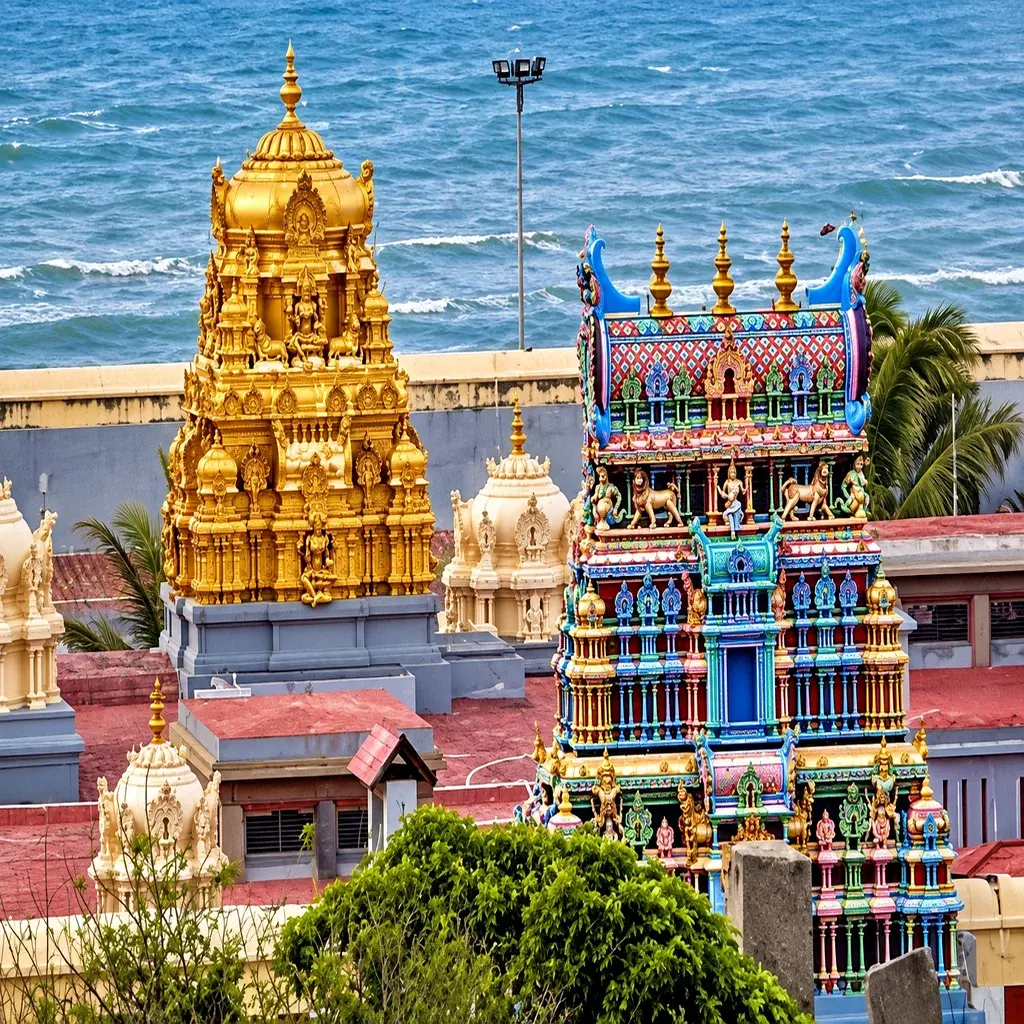
Arulmigu Devi Kanyakumari Bhagavati Amman Temple
அருள்மிகு தேவி கன்னியாகுமரி பகவதி அம்மன் திருக்கோயில்
Sri Kanyaka Parameswari · Kanyakumari, Tamil Nadu
Ancient
About the temple
One of the foremost 51 Maha Shakti Peethams (Back/Spine Peetham); situated at the southernmost tip of peninsular India at the confluence of three oceans (Bay of Bengal, Arabian Sea, and Indian Ocean); celebrated for the virgin goddess’s eternal penance for Lord Shiva; renowned for the blinding diamond nose ring whose brilliance was traditionally mistaken for a lighthouse by passing mariners. Traditional belief: Removal of marriage obstacles, attainment of mental purity, destruction of demonic illusions (Banasura Samharam), and spiritual liberation.
Temple information
- Darshan timings
- 04:30 – 20:30
- Best time to visit
- Early morning hours on mid-week non-festival days to experience a peaceful darshan atmosphere
Deity
Sri Kanyaka ParameswariGanesha Family
- Deity form
- Exquisite standing black stone vigraha of virgin Goddess Kanyakumari holding a rosary (Akshamala) in penance posture, adorned with a world-famous dazzling diamond nose ring
- Religious tradition
- Vedic Agamic Shakta Tradition & Triveni Sea Confluence Heritage
- Sanskrit name
- श्री देवी कन्याकुमारी भगवती अम्बा मन्दिरम्
- Also known as
- Kanyakumari Temple, Kanya Devi Temple, Southern Tip Shakti Peetham, Devi Kanya Kumari Temple
Darshan hours
- Daily
- 04:30 AM - 12:30 PM, 04:00 PM - 08:30 PM
- Break timings
- 12:30 PM - 04:00 PM (Sanctum closed; oceanfront remains open)
- Special days
- Navaratri, Chitra Pournami, Vaikasi Visakam: 04:00 AM - 11:30 PM (Continuous Darshan)
- Festival timings
- Open continuously till 11:30 PM during Navaratri and festival peaks
Aarti & rituals
- Morning aarti
- 05:00 AM
- Midday aarti
- 12:00 PM
- Evening aarti
- 06:00 PM
- Night aarti
- 08:00 PM
- Special aarti days
- Every Friday, Tuesday, Full Moon (Pournami), Navaratri days
- Ritual schedule
- Nitya Chatukkala Puja, Sahasra Kumkumarchana, Triveni Sangama holy bath, Sandal paste Alankara, Golden Chariot procession
- Pooja timings
- 05:00 AM - 12:00 PM, 04:30 PM - 08:00 PM
- Abhishek timings
- 05:30 AM - 07:00 AM, 11:30 AM - 12:00 PM
- Special poojas
- Available
- Online pooja booking
- No
History & heritage
- Historical period
- Ancient
- Built by
- Pandya Kings; expanded by Chola Emperors (Rajaraja I) and Travancore Maharajas
- Architect / builder
- Master traditional Dravidian stone sculptors of the Pandya court
- Construction materials
- Solid dressed dark granite stone blocks, marine-grade stone revetment, brass flagstaff
- Historical events
- Mentioned in Periplus of the Erythraean Sea (1st Century CE) as a holy port and virgin shrine; Swami Vivekananda worshipped here in 1892 before meditating on the rock
- Renovations
- Continually protected and renovated under Tamil Nadu HR&CE Department with new sea-front barricades, marble flooring, and modernized queue complexes
- Archaeological importance
- Priceless living Shakti Peetham monument with inscriptions in Tamil and Vattezhuttu dating back over a thousand years
- Legends
- Goddess Kanya Kumari was to marry Shiva of Suchindram; sage Narada created a false rooster crow to stop the wedding so she could remain virgin to slay demon Banasura
- Inscriptions
- Stone inscriptions in Tamil dating from the 10th to 16th century recording grants by Pandya and Chola rulers
Architecture
- Architectural style
- Dravidian
- Architectural period
- 10th Century core with 16th Century CE expansions
- Structure
- Fortified beachfront stone temple surrounded by high granite walls guarding against oceanic tides, featuring entrance gopuram, pillared navaranga, and sea ghats
- Floors
- 1
- Gopuram
- Stepped Dravidian entrance Rajagopuram facing north, decorated with colorful stucco sculptures of Shakti legends
- Mandapa
- Pillared Navaranga and Mani Mandapa supported by carved granite pillars depicting Shakta themes and celestial maidens
- Sculptural features
- Radiant standing black stone idol of virgin Goddess Kanyakumari holding a rosary; dazzling diamond nose ring; shrines of Vinayaka and Surya
- Artistic elements
- Intricate stone ceiling rosettes, embossed silver sanctum frames, gold-plated kalashas, and traditional brass oil lamps
- Construction technique
- Interlocking monolithic granite block masonry engineered directly on the rocky sea-promontory
- Unique features
- The dazzling diamond nose ring (Mookuthi) whose radiant sparkle is visible far into the sea; the eastern sea gate is opened only five times a year for festivals
Festivals & events
- Festival calendar
- Ashwayuja Navaratri, Chitra Pournami, Vaikasi month (May/June Car Festival)
- Special celebration days
- Every Friday, Tuesday, Full Moon day (Pournami), New Moon day (Amavasya)
- Cultural events
- Classical music concerts, Bharatanatyam performances, and coastal Theerthavari processions during festivals
- Annual events
- The monumental Vaikasi Car Festival and Navaratri Pari Vettai drawing over 200,000 devotees
- Peak crowd season
- Throughout the year; peak during December-January, Navaratri, and Chitra Pournami
Visitor information
- ✓ Parking
- ✓ Restrooms
- ✓ Drinking water
- ✓ Shoe keeping
- ✓ Prasadam counter
- Dress code
- Traditional
- Best time to visit
- Early morning hours on mid-week non-festival days to experience a peaceful darshan atmosphere
- Parking capacity
- 50+ vehicles
- Parking fees
- Approx. 20-50 INR
- Donation counters
- Yes
- Donation methods
- Cash, UPI, Bank Transfer
- Prasadam
- Vibhuti/Kumkum.