
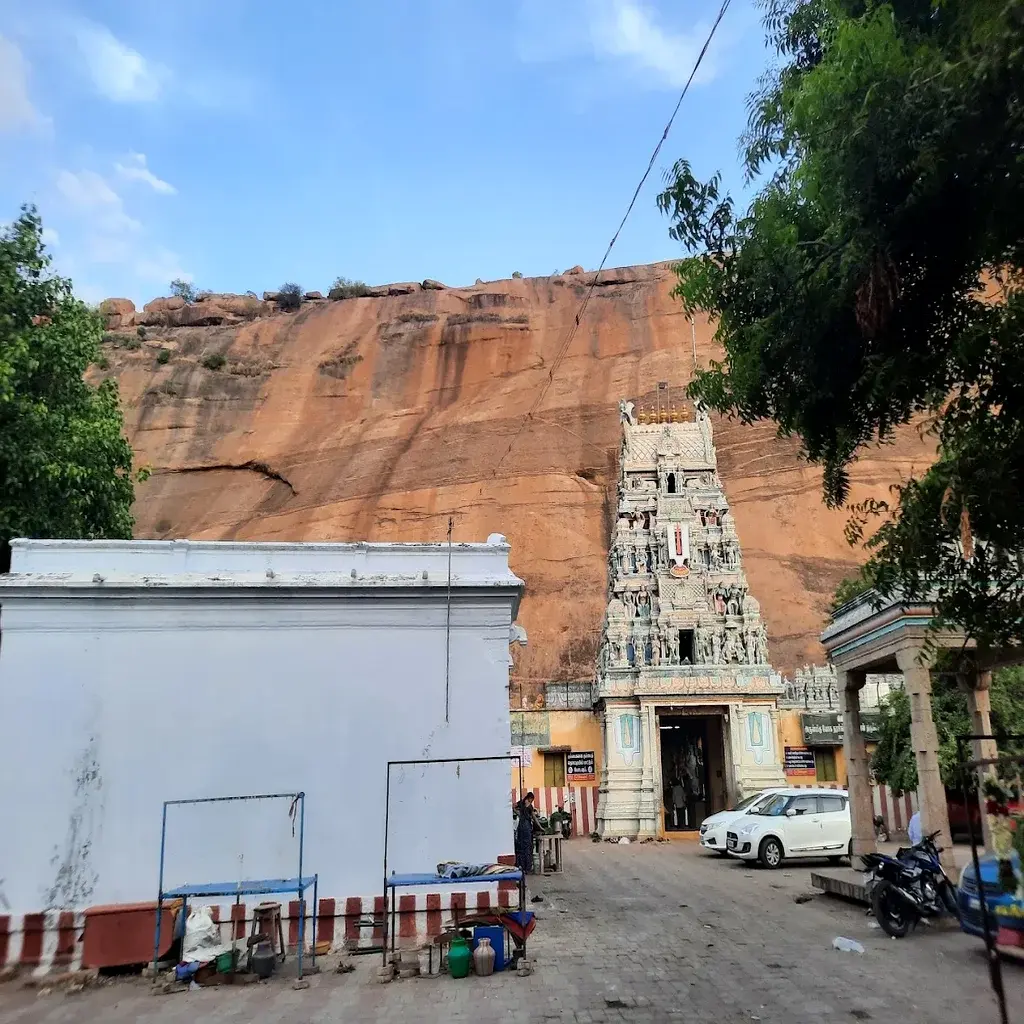
Arulmigu Yoga Narasinga Perumal Temple
அருள்மிகு யோக நரசிங்கப் பெருமாள் திருக்கோயில்
Lord Adikesava Perumal (Vishnu) · Madurai, Tamil Nadu
Ancient
About the temple
The foremost rock-cut cave temple of Lord Narasimha in Southern Tamil Nadu; excavated into the sheer northern cliff face of the monumental 4 km long Yanamalai (Elephant Hill); consecrated in 770 CE with rare Grantha-Vattezhuttu foundation inscriptions; famed for the sacred Chakra Theertham created by the Lord’s Sudarshana Chakra. Traditional belief: Complete removal of internal rage and chronic depression, attainment of meditative stillness (Yoga Siddhi), protection from enemies, and relief from karmic afflictions.
Temple information
- Darshan timings
- 06:30 – 20:00
- Established
- 770
- Best time to visit
- Early morning hours on mid-week non-festival days to experience a peaceful darshan atmosphere
Deity
Lord Adikesava Perumal (Vishnu)HanumanGaruda Alwar
- Deity form
- Colossal monolithic rock-cut cave idol of Lord Yoga Narasimha seated in Padmasana posture with Yogapatta band around his knees, radiating calm yogic power
- Religious tradition
- Vedic Pancharatra Agamic Tradition & Early Pandyan Rock-Cut Architecture
- Sanskrit name
- श्री योगनृसिंह पेरुमाल मन्दिरम्
- Also known as
- Yanamalai Narasingam Temple, Elephant Hill Narasimhar Temple, Pandya Cave Temple Narasingam
Darshan hours
- Daily
- 06:30 AM - 12:00 PM, 04:30 PM - 08:00 PM
- Break timings
- 12:00 PM - 04:30 PM
- Special days
- Narasimha Jayanthi, Swati Nakshatram, Masi Makham: 04:30 AM - 10:30 PM
- Festival timings
- Open continuously till 10:30 PM on Swati Nakshatram and festival days
Aarti & rituals
- Morning aarti
- 07:30 AM
- Midday aarti
- 11:45 AM
- Evening aarti
- 06:00 PM
- Night aarti
- 07:45 PM
- Special aarti days
- Every Swati Nakshatram, Saturdays, Ekadashi, Purattasi Saturdays
- Ritual schedule
- Nitya Thiruvaradhana, Thulasi Archana, Sudarshana Homam, Swati Thirumanjanam, Chakra Theertha Snana, Mangala Harathi
- Pooja timings
- 06:30 AM - 11:45 AM, 04:30 PM - 07:45 PM
- Abhishek timings
- Since Moolavar is an organic rock-cut cave carving, Thirumanjanam is performed with natural thailam (oils) periodically, and daily to bronze Utsava deity at 07:00 AM
- Special poojas
- Available
- Online pooja booking
- No
History & heritage
- Historical period
- Ancient
- Built by
- Excavated by Madhurakavi Marangari (Prime Minister of Early Pandyan King Nedunjadayan); sanctum consecrated by his brother Maran Eyinan in 770 CE
- Architect / builder
- Master traditional royal rock sculptors of the Early Pandyan rock-cut guild
- Construction materials
- Natural live rock-cut granite cave excavated into the sheer cliff of Yanamalai, dark granite mandapa plinth
- Historical events
- The historic foundation inscription in Sanskrit Grantha and Vattezhuttu script dated 770 CE records Marangari’s death during construction and its completion by his brother, standing as a benchmark in Indian epigraphy
- Renovations
- Protected and renovated under Tamil Nadu State Department of Archaeology and HR&CE Department with new entrance mandapam and conserved Chakra Theertham
- Archaeological importance
- Centrally Protected Monument of National Importance with foundational 8th-century Pandyan rock inscriptions
- Legends
- Sage Romasha performed penance here to witness Lord Narasimha’s peaceful post-Hiranyaksha form; the Sudarshana Chakra cooled the furious Lord, creating the holy Chakra Theertham lake
- Inscriptions
- Bilingual foundation inscription in Sanskrit (Grantha) and Tamil (Vattezhuttu) carved on the facade recording the 770 CE consecration by the Pandyan Prime Minister
Architecture
- Architectural style
- Dravidian
- Architectural period
- 770 CE excavation with 16th Century CE Nayaka expansions
- Structure
- Rock-cut cave sanctuary excavated into the living granite cliff of Yanamalai hill, with structural pillared hall, Narasingavalli Thayar shrine, and sacred lotus pond
- Floors
- 1
- Gopuram
- Stepped stone and stucco entrance gateway set against the sheer monolithic granite cliffs of Yanamalai
- Mandapa
- Pillared Mahamandapa supported by massive square granite columns depicting Early Pandyan motifs and Vaishnava devatas
- Sculptural features
- Colossal monolithic rock-cut cave icon of Lord Yoga Narasimha seated with Yogapatta; stone Narasingavalli Thayar; carved stone Garuda facing cave entrance
- Artistic elements
- Pristine 8th-century Early Pandyan rock-cut bas-reliefs, deep lotus medallions, and calligraphic Vattezhuttu inscriptions
- Construction technique
- Monolithic rock excavation carving the deity directly out of the mountain cliff without jointing
- Unique features
- The colossal rock-cut cave deity carved directly into the living granite mountain, and the famous foundation inscription dated accurately to 770 CE
Festivals & events
- Festival calendar
- Vaikasi Swati (Narasimha Jayanthi), Masi Makham, Margashirsha Shukla Ekadashi
- Special celebration days
- Every Swati Nakshatram, Saturdays, Ekadashi
- Cultural events
- Devotional bhajans, Carnatic music concerts, and Harikatha during Narasimha Jayanthi and Masi Makham
- Annual events
- The monumental Masi Makham Gajendra Moksham festival where the processional deity visits the river bed
- Peak crowd season
- October to February, every monthly Swati Nakshatram, and during Purattasi month
Visitor information
- ✓ Parking
- ✓ Restrooms
- ✓ Drinking water
- ✓ Shoe keeping
- ✓ Prasadam counter
- Dress code
- Traditional
- Best time to visit
- Early morning hours on mid-week non-festival days to experience a peaceful darshan atmosphere
- Parking capacity
- 50+ vehicles
- Parking fees
- Approx. 20-50 INR
- Donation counters
- Yes
- Donation methods
- Cash, Hundi
- Prasadam
- Vibhuti/Kumkum.